

Table of Contents
The Shift That Already Happened — Whether Brands Noticed or Not
There is a version of this conversation that brands have been having for about fifteen years — the one where data-driven strategy is framed as a future possibility, something forward-looking organisations are moving toward, a competitive advantage for those willing to invest in it early.
That conversation is over. The shift happened. It did not happen on a particular date or with a particular announcement. It happened gradually, then all at once — through the accumulation of a hundred smaller changes in how consumers behave, how media is bought, how performance is measured, and how market share is won and lost.
The brands that recognised this early built capabilities quietly and ran ahead. The brands that treated it as optional watched their category economics change in ways that made their old approaches less and less effective. And the brands that are still debating whether data-driven strategy is worth the investment are, in most cases, already behind — not dramatically, but measurably, in the ways that compound.
This is not a technology story, though technology is part of it. It is a story about how the nature of competition between brands has changed — what information is now available about consumers, what precision is now possible in reaching them, and what accountability is now expected from every rupee of marketing investment. In that environment, relying on instinct and habit is not bold or creative. It is just expensive.
This post is about what data-driven strategy actually means for a brand operating in India today — not in the abstract, but in the specific, practical, sometimes uncomfortable ways it changes how decisions are made, budgets are allocated, and campaigns are evaluated.
What “Data-Driven” Actually Means — And What It Doesn’t
The phrase has been used so many times, in so many contexts, that it has started to function more as a signal of intent than as a description of practice. Almost every agency pitch deck claims to be data-driven. Almost every brand strategy document references consumer insights. But the phrase covers an enormous range of actual practice — from genuinely transformative analytical rigour to post-hoc rationalisation dressed up in dashboards.
So it is worth being specific about what it actually means.
What it means
A data-driven strategy is one where decisions about what to spend, where to spend it, what to say, and who to say it to are made primarily on the basis of evidence — and where that evidence is updated regularly enough to influence decisions before they become irrelevant.
It means that when a budget is allocated across channels, the allocation reflects evidence about where the target audience actually spends their time, what the relative cost-efficiency of each channel has been historically, and what intent data suggests about where the audience is in their purchase journey right now. Not where a media planner thinks the audience is. Not where the audience was three years ago. Where they actually are, as evidenced by behaviour.
It means that when a campaign creative is developed, it is informed by data about what has resonated with the target audience before — which messages, which formats, which emotional registers, which product benefits. Not to the exclusion of creative instinct, but in conversation with it.
It means that success is defined before the campaign starts — in specific, measurable terms that connect marketing activity to business outcomes — and that performance is tracked against those definitions in real time rather than assembled into a report after the money is spent.
What it doesn’t mean
It does not mean removing human judgement from strategy. Data is an input to decision-making, not a substitute for it. The most sophisticated data in the world does not tell you what to value, what kind of brand you want to build, or how to create an idea that genuinely moves people. Those remain irreducibly human questions.
It does not mean optimising purely for what is measurable. One of the most common distortions in digital marketing is over-weighting activities that produce clear, attributable metrics at the expense of those that build brand value over time but are harder to connect to a single conversion. A brand that optimises entirely for short-term performance metrics can hollow out its long-term equity without noticing until it is already expensive to repair.
And it does not mean having access to a lot of data. Data without the discipline to ask the right questions of it, the analytical capability to extract relevant signal, and the organisational willingness to act on uncomfortable findings is just expensive storage.
Data-driven strategy is not about having more data. It is about making better decisions — and being honest enough to act on what the data actually says, even when it contradicts what you assumed.
The Cost of Running on Instinct in a Data-Rich Market
Before making the affirmative case for data-driven strategy, it is worth being direct about what the alternative costs. Because in most organisations, the default is not a considered rejection of data-driven approaches — it is simply a continuation of how things have always been done, supplemented by whatever data is easiest to access rather than most relevant to the decision.
You pay rates you do not need to pay
Media rates are not fixed. They are the outcome of negotiations, and the quality of that negotiation depends on knowledge — knowledge of what others in your category are paying, what inventory is genuinely scarce versus artificially constrained, what the media owner’s occupancy position is, and what comparable placements trade at on adjacent properties. That knowledge comes from systematic data collection across buying cycles. Without it, you are negotiating blind, and the media owner almost certainly knows more than you do.
You reach audiences that will never buy from you
Broad demographic targeting — the default for most campaigns that are not built on audience data — consistently over-reaches. Research across markets and categories suggests that between 20% and 40% of a typical media budget reaches people who are outside any reasonable definition of the target audience. In absolute terms, on a ₹10 crore media budget, that is potentially ₹2–4 crore working against you rather than for you. Data-driven audience definition is not a nice-to-have refinement — it is the difference between a campaign that builds business and one that spends budget without proportionate return.
You miss the consumers who are closest to buying
Intent data — search behaviour, category engagement, platform signals — tells you not just who your audience is demographically, but where they are in their purchase journey right now. A consumer actively searching for your product category is incomparably more valuable to reach at that moment than a demographically identical consumer who has no current purchase intention. Running campaigns at constant weight throughout the year, regardless of intent cycles, means spending heavily when consumers are not thinking about buying and missing the windows when they are.
You learn nothing from one campaign to the next
Perhaps the most underappreciated cost of running on instinct is the failure to compound learning over time. Every campaign is an experiment that produces data about what works, what does not, which audiences respond, which channels perform, and which messages resonate. When that data is not systematically collected, analysed, and fed forward into the next planning cycle, you start every campaign at the same level of knowledge as the last one. The opportunity to build genuine, proprietary understanding of your category and your consumers — understanding that competitors cannot replicate — is lost quietly, one campaign at a time.
Your competitors are not standing still
In most competitive categories in India right now, at least one competitor is investing seriously in data capability — better audience intelligence, more rigorous attribution, faster optimisation loops, more precise regional targeting. The relative advantage they build compounds. Market share movements in data-mature categories are increasingly being driven not by creative superiority or budget advantage but by the quality of the underlying strategic intelligence. A brand that continues to operate on instinct in a category where competitors are operating on evidence will, over time, find itself in an increasingly expensive position to recover from.
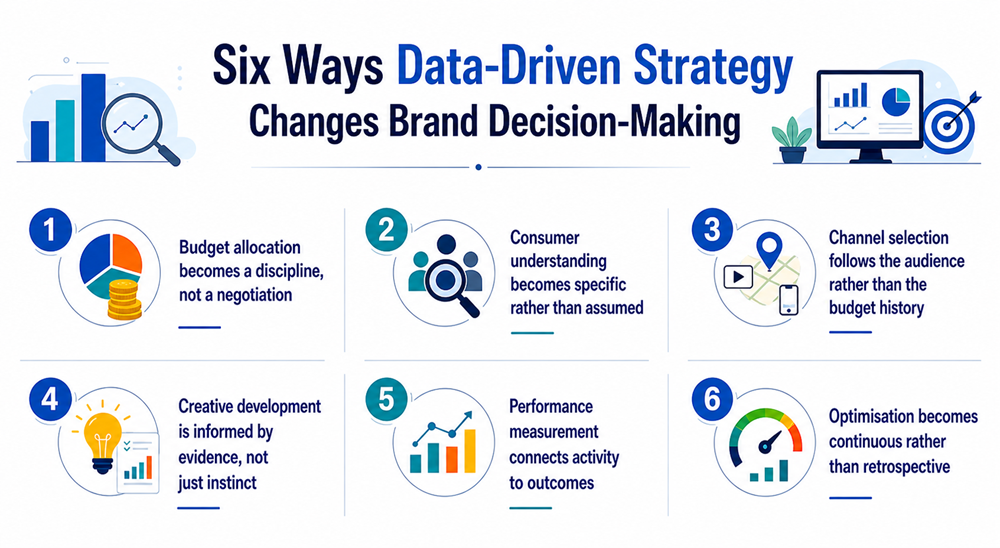
Six Ways Data-Driven Strategy Changes Brand Decision-Making
1. Budget allocation becomes a discipline, not a negotiation
In most marketing organisations, the annual budget allocation process is heavily influenced by internal politics, departmental inertia, and the loudest voice in the room. Television gets its share because it always has. Digital gets a percentage because it seems modern. Print gets what is left because nobody wants to argue about it.
A data-driven allocation process looks different. It starts with evidence of where the target audience actually spends their time, what channels have historically driven the best cost-per-outcome for this specific brand and category, and what intent data suggests about current purchase readiness. From that foundation, budget is allocated to where it is most likely to produce the desired outcome — not where it has always gone, and not where it is easiest to defend internally.
This is genuinely uncomfortable for organisations used to the old process. It requires being willing to move budget away from channels that are familiar and toward ones that the evidence supports, even when that means changing habits of years. The brands that have made this shift consistently report significant improvements in marketing efficiency — not because they spent more, but because they allocated what they already had more intelligently.
2. Consumer understanding becomes specific rather than assumed
Most brands have a target audience description that has been in the marketing brief for years: “urban homeowners aged 30–50, SEC A and B, aspirational, quality-conscious.” That description is usually derived from research that was conducted several years ago, interpreted generously, and then inherited by every successive marketing team without being questioned.
Data-driven strategy replaces this with ongoing, evidence-based audience intelligence. Who are the people actually purchasing your product right now — not who you assumed would purchase it, but who actually is? What do they search for before they buy? What content do they consume? What other categories and brands are in their consideration set? How do they differ from your assumed target, and what does that difference mean for your messaging and channel strategy?
The answers to these questions are often surprising. In our experience planning media for Indian brands across categories, the actual buyer profile frequently diverges from the assumed one in ways that are commercially significant — younger than assumed, more regionally concentrated, more influenced by peer recommendation than by aspirational imagery, or more price-sensitive at certain purchase occasions than the brand’s positioning suggests. Data surfaces these realities; instinct tends to confirm what the team already believed.
3. Channel selection follows the audience rather than the budget history
Channel selection is the decision with the largest single impact on campaign efficiency, and it is also the one most commonly made on the basis of habit rather than evidence. This channel worked last year, so it goes in this year’s plan. This channel is where our brand has always been, so reducing it feels like losing ground. This channel is new and interesting, so it gets a test budget regardless of whether the target audience is actually there.
Data-driven channel selection starts instead with a question that seems obvious but is rarely asked rigorously: where does our specific target audience in our specific geography spend their media time, in what context, at what moments of receptivity? The answer varies significantly by category, by geography, by age cohort, and by the stage of the purchase journey being addressed. A channel strategy built on the answer to that question will almost always look different from one built on last year’s flowchart.
4. Creative development is informed by evidence, not just instinct
Creative strategy has traditionally been the domain most resistant to data input — and there are good reasons for that resistance. Numbers cannot tell you what an idea is worth before it exists, and the history of advertising is full of campaigns that tested poorly and performed brilliantly, and vice versa. Creative instinct is real and valuable, and it should not be subordinated to data that measures the wrong things.
But the appropriate response to that truth is not to keep data out of creative development entirely. It is to be clear about what data can and cannot tell you, and to use it appropriately. Data can tell you which product benefits resonate most with which audience segments. It can tell you which creative formats hold attention in which contexts. It can tell you how past campaigns have performed against various messages and emotional registers. It can tell you what your target audience is searching for and what language they use when they describe their needs. All of that is genuinely useful input to a creative brief — without reducing the creative process to a formula.
5. Performance measurement connects activity to outcomes
Perhaps the most fundamental change that data-driven strategy brings to a marketing organisation is in how success is defined and measured. In a pre-data environment, campaign success was typically measured in terms of inputs — GRPs delivered, impressions served, reach achieved — and claimed outcomes that were difficult to connect causally to the marketing activity. Brand health tracking improved, sales went up, so the campaign worked. Maybe. Or maybe the sales went up for other reasons, and the campaign happened around the same time.
A data-driven measurement framework starts by defining, before the campaign starts, what specific, measurable business outcomes the activity is designed to produce — and building the measurement infrastructure to track those outcomes with enough rigour to distinguish the effect of the campaign from other variables. This is hard to do perfectly. Attribution modelling is an imperfect science, particularly in markets where the purchase journey spans both online and offline touchpoints. But the discipline of trying to connect activity to outcomes, even imperfectly, produces dramatically better decisions than measuring only what is easy to count.
6. Optimisation becomes continuous rather than retrospective
Traditional campaign management had a clear rhythm: brief, plan, produce, execute, measure, report, repeat. The measurement phase happened after the campaign ended. Learnings from one campaign were applied — if at all — to the next one, which might be months away.
In a data-rich environment, that rhythm is obsolete. The data produced by a running campaign — delivery data, audience data, performance data, creative engagement data — is available in real time and can be acted on while the campaign still has budget left to spend. A creative that is underperforming can be replaced mid-flight. A channel that is delivering poor cost-per-outcome can be deprioritised before it consumes its full allocation. A geographic market that is overperforming can receive incremental budget while it is still converting efficiently.
This shift from retrospective reporting to live optimisation changes the fundamental economics of campaign management. Errors are corrected before they become expensive. Successes are amplified while the opportunity exists. And the total efficiency of the campaign improves not because the plan was better at the start, but because the team was better at adapting it as evidence accumulated.
The India Dimension: Why Data Matters Even More Here
Data-driven strategy matters everywhere, but there are specific characteristics of the Indian market that make it particularly valuable — and particularly challenging to implement well.
The complexity of language and regional fragmentation
India is not one consumer market. It is dozens of markets, overlapping in some ways and deeply distinct in others, fragmented by language, region, urban-rural distribution, cultural context, and economic development. A consumer in Coimbatore and a consumer in Chandigarh may share the same demographic profile and buy the same product — but the media they consume, the language they respond to, the reference points that make a message resonate, and the channels through which they reach a purchase decision are fundamentally different.
This fragmentation makes generic, instinct-based planning extraordinarily expensive. A national media plan that treats India as a single audience is systematically under-serving most of the actual markets it is trying to reach. Data makes regional precision possible: intent data by geography, audience composition by language and platform, purchase behaviour by city tier. The brands that have built the discipline to plan at this level of regional granularity are consistently outperforming national plans in the markets that matter most to their growth.
The pace of consumer behaviour change
The Indian consumer’s media diet has changed faster in the last five years than in the previous twenty. The shift from linear television to OTT streaming. The explosion of short-form video consumption in regional languages. The growth of digital commerce in tier-2 and tier-3 cities. The rapid penetration of smartphones into markets that were feature-phone dominated until recently. Each of these shifts has changed where consumers spend their attention and where the opportunity to reach them effectively lies.
In a market changing at this pace, strategies built on research that is two or three years old are likely to be wrong in ways that are not immediately visible. The audience has moved. The channels they trust have changed. The messages that resonate have shifted. Only continuous, current data can keep a brand’s strategy aligned with where consumers actually are — rather than where they were when the last major research study was conducted.
The tier-2 and tier-3 opportunity
One of the most significant structural opportunities in Indian marketing right now is the tier-2 and tier-3 consumer — and it is also one of the least well-served by the data practices of most national brands. These consumers are online in large numbers, increasingly transacting digitally, and consuming media on platforms that most big-city marketing teams have not systematically analysed.
The data exists to reach them intelligently. Search intent data, regional platform audience data, e-commerce penetration data by district, and social media audience composition data all provide a basis for planning campaigns that reach these consumers in their actual media environments, with messages in their language, at moments of genuine purchase intent. The brands investing in this intelligence now are building market share in geographies that will drive the majority of India’s consumer market growth over the next decade.
Cricket, IPL, and event-driven buying
India’s media landscape is more event-driven than almost any other major market, and the event that dominates it — the Indian Premier League — creates a media buying environment with no real equivalent elsewhere. During IPL, television inventory effectively disappears at rational prices for brands that have not committed far in advance. Digital video CPMs spike as streaming audiences concentrate. Brand visibility during matches is commercially significant for categories ranging from consumer electronics to beverages to financial services.
Data is essential for making rational decisions in this environment. Without category intent data, competitive intelligence, and audience composition analysis, the IPL buying decision comes down to intuition about whether the premium is worth it — which is exactly the kind of decision that benefits most from evidence. The brands that use data to evaluate the IPL opportunity specifically, rather than defaulting to either always buying it or always avoiding it on principle, consistently make better investment decisions around the tournament.
Data-Driven Does Not Mean Creativity-Free
This is worth saying explicitly, because the most common objection to data-driven strategy from creative teams — and it is a legitimate concern — is that quantitative rigour will crowd out the intuitive, unexpected, emotionally resonant work that actually builds brands.
The concern is not unfounded. There are genuine examples of brands that have pursued data-driven optimisation so aggressively that they have optimised all the distinctiveness out of their advertising, producing work that performs reasonably well against short-term metrics and builds nothing that lasts. Performance marketing taken to its logical extreme produces efficient transactions and no brand.
But this is a failure of application, not of the approach. Data and creativity are not in opposition — they are most powerful in combination.
Data is exceptionally good at telling you about the world as it is: what consumers are thinking about, what language they use to describe their needs, what content they are engaging with, what your brand currently stands for in their minds, what your competitors are saying. That is valuable input to a creative brief. It does not write the brief for you.
Creativity is exceptionally good at imagining the world as it could be: how a brand could be positioned that it is not currently, what emotional territory it could own, what idea could change how people feel about a category. Data cannot generate that. It can only tell you whether it worked after the fact.
The best creative strategies we have seen are ones where the data has sharpened the brief — clarifying the genuine insight, focusing the message on what actually matters to the consumer, directing the creative energy toward territory where the brand can credibly win — and then allowed the creative team to do what creative teams do best within that focused frame. The result is work that is both strategically sound and genuinely interesting. That combination, in our experience, consistently outperforms work that is either creatively ambitious without strategic grounding or strategically rigorous without creative ambition.
Data sharpens the brief. Creativity answers it. Neither works well without the other.
The Organisational Shift: From Reporting to Decision-Making
One of the most underappreciated challenges in becoming a genuinely data-driven brand is not the data itself. It is the organisational change required to use data well.
Most marketing organisations have access to more data than they use. They have platform dashboards, campaign reports, brand tracking studies, sales data, social listening tools, and agency analytics. The data is there. The problem is that it rarely reaches decision-makers in a form that is timely, clear, and actionable enough to actually change a decision before it is made — rather than rationalising a decision that has already been made, or documenting the results of a campaign that has already ended.
The reporting trap
Reporting and analysis are not the same thing. A dashboard that shows last week’s impression delivery, click-through rates, and reach numbers is reporting. Analysis is the process of asking what those numbers mean for the decision you need to make today — whether to continue the current approach, where to reallocate budget, which audience segment to prioritise, whether the creative is working.
Most marketing teams are drowning in reports and starving for analysis. The reports come in regularly, are briefly reviewed, and then filed — because the team does not have the time, the analytical capability, or the organisational mandate to translate report data into decisions. This is not a data problem. It is a process and culture problem, and it is the most common bottleneck we see between brands that claim to be data-driven and brands that actually are.
What the shift requires
Becoming genuinely data-driven requires changing not just what data you have access to but how decisions are made. Specifically, it requires:
- Defining in advance what data is relevant to each key decision — and building the systems to collect and deliver that data on the decision timeline, not the reporting timeline.
- Creating organisational space for data to change decisions rather than only confirm them. If data that contradicts the current strategy is consistently explained away rather than acted on, the organisation is performing data-drivenness rather than practising it.
- Building analytical capability — either internally or through agency partners — that can move from raw data to actionable recommendation quickly enough to be useful.
- Connecting marketing data to business outcomes data so that campaign performance is evaluated in terms that the broader organisation cares about — not just marketing metrics that are disconnected from revenue, market share, or customer acquisition cost.
- Making data literacy a baseline expectation for marketing leadership — not a specialist skill delegated to an analytics team that nobody listens to.
The agency’s role
A brand’s agency partner plays a critical role in this shift — or should. An agency that delivers campaign reports without analytical recommendations, that measures success in impressions and GRPs without connecting those metrics to business outcomes, and that plans the next campaign from the same starting point as the last one regardless of what the data showed is not a data-driven agency, regardless of what the pitch deck says.
A genuinely useful agency partner brings structured analytical capability to every campaign review, surfaces the findings that are uncomfortable as well as the ones that confirm the strategy, and makes specific, evidence-based recommendations for how the next plan should differ from the last one. That is the standard worth holding agency relationships to.
Common Mistakes Brands Make With Data — And How to Avoid Them
Confusing data access with data capability
Having access to a lot of data is not the same as being able to use it well. Many brands invest in data tools, platforms, and subscriptions — and then find that the data sits in dashboards that nobody knows how to interpret, or gets compiled into reports that inform no decisions. Data capability is not just about access. It is about the analytical skills to ask useful questions of the data, the process discipline to act on the answers, and the organisational culture to accept findings that challenge existing assumptions. All three are required. Access alone delivers very little.
Optimising for the wrong metric
In digital marketing especially, it is tempting to optimise for the metric that is easiest to improve rather than the one that actually matters. Click-through rates, cost-per-click, video completion rates — these are easy to move with targeting and creative adjustments, and they look good in reports. But if they are not connected to business outcomes — sales, market share, brand preference, customer lifetime value — optimising for them may be improving the dashboard while degrading the actual performance of the brand.
Before any data-driven optimisation process begins, the brand and agency need to agree on which metrics ultimately matter — and build the measurement framework backward from those business outcomes rather than forward from whatever the platform measures by default.
Treating historical data as predictive without qualification
What worked last year is the best available evidence for what might work this year — but it is not a guarantee, and in a rapidly changing market like India, it may not even be the best guide. Consumer behaviour changes. Platforms shift. Competitive dynamics evolve. Historical data should inform planning, but it should always be tested against current intelligence rather than treated as a fixed blueprint.
Ignoring qualitative insight
Data tells you what is happening. It rarely tells you why. A brand whose sales have declined in a particular region can see the decline in the data, but understanding whether it reflects a distribution problem, a competitor’s campaign, a shift in consumer preference, or a pricing issue requires qualitative investigation that data alone cannot provide. The best analytical frameworks combine quantitative data with qualitative consumer understanding — because the numbers only become actionable when you understand the human behaviour behind them.
Using data to justify decisions rather than make them
This is perhaps the most common and most insidious data mistake. The decision has already been made — based on instinct, politics, or inertia — and data is then selectively cited to support it. In this mode, data functions as decoration rather than input. The organisation feels data-driven because it mentions data, but the actual decisions are being made on the same basis they always were.
The test of genuine data-drivenness is simple: has the data ever led to a decision that would not otherwise have been made? Have campaign budgets been reallocated against internal resistance because the evidence demanded it? Have cherished channels been deprioritised because the data showed poor performance? Has a creative direction been abandoned mid-flight because the audience data did not support it? If the answer to these questions is no, the organisation is reporting on data, not being driven by it.
What a Genuinely Data-Driven Brand Looks Like in Practice
It is useful to make this concrete. A genuinely data-driven brand does not look dramatically different from the outside — the advertising still appears in the same places, the products are still the same, the campaigns still tell stories. The difference is in what is happening behind the decisions.
Before a brief is written, the planning team has reviewed current search intent data for the category, updated the audience intelligence from the last campaign, and assessed the competitive media landscape. The brief reflects what the data actually says about the consumer right now, not what was true when the last brand study was conducted.
When the media plan is presented, every channel recommendation is supported by evidence: this channel reaches this proportion of the target audience at this cost-efficiency, based on this data source. Channels are recommended because the audience is there, not because they were in last year’s plan. Regional allocations reflect intent data, not just population distribution.
During the campaign, someone is watching the numbers every day — not to produce a report, but to make decisions. When a creative variant underperforms, it is replaced. When a channel over-delivers reach at low cost in a high-priority market, incremental budget is moved there. When frequency builds too fast in one segment, the targeting is adjusted.
After the campaign, the post-campaign analysis answers specific questions about what worked and what did not — and those answers go directly into the next brief. The next plan starts with more knowledge than the last one. Over time, the brand’s understanding of its own consumers and its own category becomes a genuine competitive asset that is difficult for a less disciplined competitor to replicate quickly.
This is not a description of a brand with extraordinary resources or exotic technology. It is a description of a brand with good process, good analytical discipline, and an agency partner that treats every campaign as a source of learning as well as a source of results.
The Honest Limits — What Data Cannot Do
Having made the case for data-driven strategy at length, it is important to be equally clear about what it cannot do — because over-confidence in data creates its own category of expensive mistakes.
Data cannot tell you what to value. The decision about what kind of brand to build, what positioning to own, what emotional territory to occupy — these are questions of judgement and ambition, not analysis. Data can tell you what is possible and what is likely to work, but it cannot tell you what is worth doing.
Data cannot predict discontinuities. The best dataset in the world, analysed with the most sophisticated tools available, will not reliably predict a competitor’s unexpected launch, a cultural moment that changes category dynamics overnight, a platform algorithm change that invalidates your targeting model, or a macroeconomic shift that changes consumer priorities across the board. Data is calibrated to the past. Strategy must account for a future that will not always resemble it.
Data cannot replace creativity. We have said this already, but it bears repeating in this context. The ideas that change how people feel about a brand — that create genuine affinity, genuine preference, genuine loyalty — are not produced by analysis. They are produced by creative intelligence working in dialogue with analytical intelligence. Neither alone is sufficient.
Data cannot compensate for a weak product or a poor consumer experience. Increasingly precise targeting of the wrong message about the wrong product to exactly the right consumer is still a waste of money. Data-driven strategy amplifies the effect of good underlying brand fundamentals. It does not substitute for them.
The goal of data-driven strategy, honestly understood, is not certainty. It is better decisions, made more quickly, corrected more efficiently, and compounded more systematically over time. That is a meaningful and achievable advantage. It is worth pursuing seriously and maintaining honestly.
Where Most Indian Brands Are Right Now — And Where the Gap Is
Based on our experience working with brands across categories and sizes in India, the honest picture is one of significant variance — and significant opportunity for most.
A small number of large Indian and multinational brands are genuinely sophisticated in their data practice. They have first-party data infrastructure, marketing mix models, real-time attribution frameworks, and the organisational processes to translate analytical findings into decisions quickly. They are, in most cases, pulling measurably ahead of less data-mature competitors.
A larger number of brands are in transition — they have invested in data tools and analytics capability, but the organisational process of actually using data to make decisions is still developing. Reports are produced but not always acted on. Data is cited in strategy documents but does not consistently change channel allocation or creative direction. The capability exists; the discipline to apply it consistently is still being built.
And a significant number — particularly among mid-sized Indian brands with strong traditional media presence and established category positions — are still operating largely on instinct and habit, investing in analytics as a reporting function rather than a decision-making one. Many of these brands are still growing, which makes the case for change harder to make internally. But the category leaders in most sectors are investing in data capability, and the gap between data-mature and data-immature competitors will compound.
The most common specific gaps we see across brands, regardless of size:
- First-party data that sits in CRM and e-commerce systems but is never integrated with media planning
- Post-campaign analysis that answers the wrong questions — delivery numbers rather than business outcomes
- Regional planning that is built on national averages rather than local intent data
- Channel allocation that reflects history rather than current audience behaviour
- Creative strategy that is developed without systematic input from audience intelligence
- Measurement frameworks that track marketing metrics rather than business outcomes
None of these gaps is insurmountable. All of them are addressable with the right process, the right analytical capability, and — crucially — the organisational willingness to let data change decisions rather than just document them.
Conclusion
The brands winning in India today are not, in most cases, winning because they are spending more. They are winning because they are spending with more clarity — about who they are trying to reach, where those people actually are, what messages resonate with them, and what the evidence from every previous campaign says about how to do it better.
That clarity is what data-driven strategy delivers. Not certainty — the market is too complex and too fast-moving for certainty. But consistently better decisions, made faster, corrected more efficiently, and built on a compounding foundation of proprietary knowledge about your own consumers and category.
For brands that have not yet made data-driven strategy a genuine organisational discipline — not just a phrase in the annual report, but a real change in how decisions are made — the question is not whether to make the shift. The question is how long to wait before the cost of not making it becomes visible in the numbers.
At Alliance, we have been planning media in India for over 30 years. We have watched the data available to planners go from almost nothing to extraordinary richness in the time we have been operating. What has not changed is the underlying discipline: understand your audience, place your message where they are paying attention, measure what actually matters, and keep learning. Data just makes all of that dramatically more precise — and dramatically more accountable.
If you are thinking about how to build a more genuinely data-driven approach to your brand’s strategy — whether that is in media planning, campaign measurement, audience intelligence, or all three — we are happy to talk through what that could look like for your specific situation.