
Table of Contents
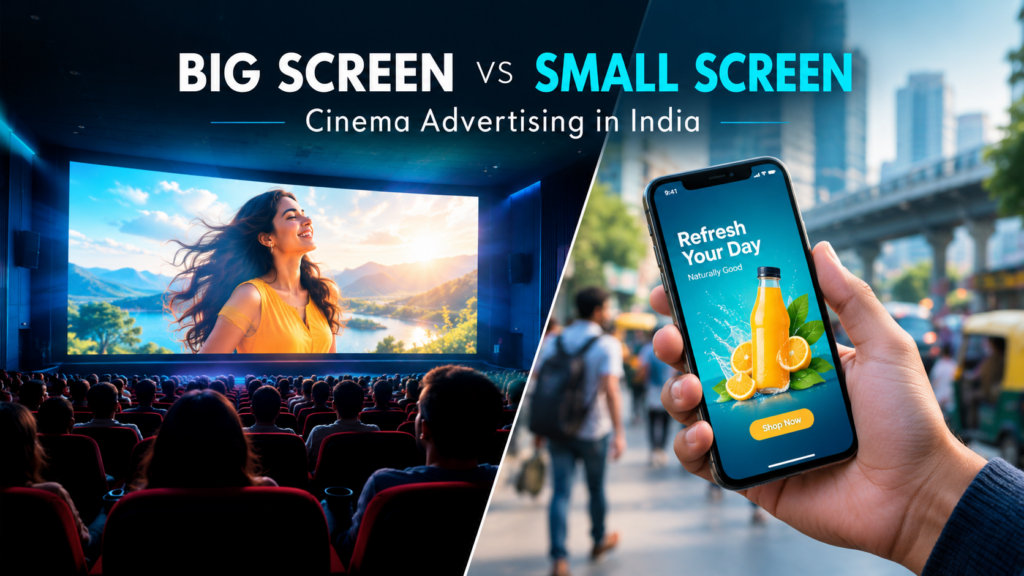
Think about the last time you watched an ad on your phone. You probably had a second tab open and a notification waiting. The ad ran for five seconds, and you skipped it on the sixth, or never really looked at it at all.
Now think about the last time you sat in a cinema hall. The lights were down and the phone was in your pocket. The sound was loud enough to feel in your chest. Whatever appeared on that 40-foot screen, you saw it.
That difference is the reason cinema advertising in India is still worth a serious look in 2026, even in a world of reels, connected TV and programmatic everything. At Alliance Advertising & Marketing, we ask a simple question when a brand comes to us with a media plan: where will this message actually be noticed? For a surprising number of campaigns, the honest answer is a darkened auditorium.
This guide explains how cinema advertising works in India, what it costs, where it outperforms television and digital, and where it doesn’t. We’d rather help you spend well than convince you to spend everywhere.
Why the Big Screen Still Matters in a Scrolling World
Most advertising is competing against distraction. Cinema is one of the few formats where distraction is physically reduced.
1. A captive, attentive audience. Nobody casually walks out during the ad reel. People are seated, the room is dark, and the screen is the only light source. Attention here is the default state.
2. Sensory scale. A film screen with Dolby-grade sound doesn’t just show your brand. It makes the brand feel larger and more important than it would on any other screen, and that effect is hard to reproduce on a phone.
3. A mood that works for brands. People go to the movies to enjoy themselves. They arrive relaxed, often with family or friends, and are generally in a good frame of mind. An ad landing in that mood is received differently from one that interrupts a work email.
4. Premium association. Showing up alongside a major release carries a certain prestige. Launching a car, a jewellery line, a smartphone or a real estate project before a big-ticket film signals confidence.
5. A shared experience. An audience laughing together at a funny ad, or going quiet at an emotional one, is a collective reaction. It makes the ad more memorable than the same ad watched alone.
The State of Cinema Advertising in India Right Now
Cinema advertising in India is neither booming nor dying. It’s in a more interesting place than either label suggests.
According to the Pitch Madison Advertising Report 2026, cinema advertising expenditure stabilised at around Rs 877 crore in 2025. That is a market in consolidation, not freefall. The reason it hasn’t surged is worth understanding. Advertising on cinema screens rises and falls with the strength of the film calendar. In February 2026, PVR INOX management said ad revenue was slow in a quarter that lacked a big blockbuster, since advertising works on the perception of a big film. The company’s own investor summary put that quarter’s advertising revenue at Rs 118 crore, down 20.6%, owing to fewer marketable films.
The swing goes the other way as well. In the second quarter of FY26, PVR INOX’s ad revenue reached ₹126 crore, the highest since the pandemic and a 16% increase year on year. The sectors driving that were FMCG, banking, textiles, e-commerce and jewellery, followed by automobiles and retail.
The takeaway for a marketer is practical. Cinema is a content-driven medium. The film you attach your brand to matters as much as the screen it plays on. A smart cinema media plan is built around the release calendar, not just a rate card.
The infrastructure keeps growing, too. PVR INOX alone currently has 1,791 screens across 358 cinemas in 112 cities in India and Sri Lanka, and the company has said it plans to expand further, including a “Smart Screens” format aimed at Tier-II and Tier-III cities. On the sales side, Khushi Advertising, one of the larger cinema ad-sales firms, manages a network of over 9,000 screens across multiplex and single-screen chains. That tells you the opportunity extends well beyond metro multiplexes.
Cinema vs TV vs Digital: An Honest Comparison
No channel wins every time. Here is how we think about the three when planning campaigns.
Attention and recall
On TV, you compete with the remote, the kitchen and the phone in the viewer’s hand. On digital, you compete with an endless feed and a skip button. In cinema, there is very little else to look at. This is where the big screen has its clearest edge: quality of attention per impression.
Reach and frequency
TV and digital win on raw reach. A national TV campaign or a well-run digital buy will put your message in front of far more people, far more often, at a lower cost per head. Cinema reaches a smaller, more selective audience. That is a limitation if you need mass awareness, and an advantage if you want a specific audience.
Audience targeting
Digital offers detailed behavioural targeting. Cinema offers something different: context targeting through content. Audiences for a family animation film look nothing like those for an action thriller or a regional romance. You can match your message to the crowd by choosing the film, the city, the language and even the screen type.
Cost
Be realistic here. One of the trade reports we read put it plainly: cinema advertising can seem relatively expensive compared with other mass media channels. The cost per thousand impressions is higher than TV or digital. What you pay for is the quality of the impression, not the volume. We’ll come back to this below, because it changes how you should evaluate cinema.
Measurement
Digital has always had the edge on tracking. Cinema is catching up. UFO Moviez has introduced ProCAT, a platform that tracks actual cinema footfalls and lets advertisers calculate verified cost-per-impact metrics. For brands that have been hesitant because cinema felt hard to measure, this kind of tool matters.
| Factor | Cinema | TV | Digital |
|---|---|---|---|
| Attention level | Very high | Medium | Low to medium |
| Reach | Selective | Very wide | Very wide |
| Targeting | Content, city, language | Daypart, genre | Behavioural, granular |
| Cost per impression | Highest | Medium | Lowest |
| Skippable | No | Channel-switch | Often yes |
| Best for | Launches, premium brands, local activation | Mass awareness | Performance, retargeting |
When the Big Screen Really Does Beat the Small One
Cinema earns its premium in specific situations. Here are the ones where we’d recommend it most readily.
Product and brand launches. A new car, smartphone, jewellery collection or real estate project benefits from the sense of occasion that a cinema launch creates. A high-quality film shown before a major release feels like an announcement.
Premium and aspirational categories. Automobiles, luxury, jewellery, banking and high-end retail all sit naturally on the big screen. The environment adds to the brand rather than cheapening it. The sectors the industry reports as leading cinema advertising spend line up with this.
Hyperlocal activation. Cinema can be bought by city, by cinema or even by screen. If you run a showroom, a clinic, a coaching institute, a restaurant or a real estate project in a particular catchment area, you can reach people in that area at a time when they are relaxed and receptive. For many local businesses this is the most underrated use of the format.
Regional and language-specific campaigns. Regional cinema has a loyal, engaged audience. A Tamil, Telugu, Malayalam, Punjabi or Marathi film brings viewers who respond strongly to messages in their own language. Industry commentary points to a shift toward regional film-based advertising as brands focus on localised communication. If your product is regional by nature, this is a major opening.
Storytelling that needs time and sound. Some ads simply don’t work in a skippable five-second slot. If your creative depends on music, emotion, cinematography or a slow build, the cinema is where it will be received as intended.
Reaching the “light TV” household. Many younger urban viewers have moved away from linear TV and watch on their phones. Cinema reaches them in a setting where they aren’t multitasking.
When Cinema Might Not Be Your Best Choice
We’d be doing you a disservice if we pretended otherwise. Cinema is not the right answer when:
- You need mass reach on a small budget. TV and digital will stretch the rupee much further.
- You’re after immediate, trackable conversions. Performance marketing is better suited for direct-response goals, though cinema can support it by building brand memory.
- Your audience doesn’t go to the movies. Some segments simply aren’t in theatres often. Know who your buyer is before you book.
- Your creative isn’t ready. A weak ad on a big screen looks weaker. Cinema magnifies quality in both directions.
- The film calendar is thin. As the recent industry commentary shows, ad performance tracks the strength of the releases. Booking during a weak slate means paying for fewer eyeballs.
Understanding Cinema Advertising Cost in India
Many first-time advertisers ask us this first, and the honest answer is: it depends. Anyone who quotes a flat number without asking questions isn’t planning properly. The main factors that move cost include:
- City and cinema tier. A premium multiplex in a metro costs more than a smaller property in a Tier-II town.
- Chain and screen count. Booking across a national chain differs from picking a handful of local cinemas.
- Film and release timing. A major release during a festival weekend commands far higher rates than a quiet mid-week slot.
- Ad duration. Common cinema ad lengths are 10, 20, 30 or 60 seconds, and longer slots cost more.
- Format. There are on-screen ads (the film itself), and off-screen options such as lobby standees, popcorn tubs, ticket backs and branded zones.
- Campaign length. Weekly and multi-week packages usually carry better rates than one-off bookings.
- Targeting. Selecting by language, genre or audience profile changes pricing.
Because there are so many moving parts, we always encourage advertisers to work with a cinema advertising agency that can compare packages across networks instead of going to a single seller. That is how you avoid overpaying for slots that don’t match your audience.
Remember the cost-per-impression point from earlier. Cinema is not the cheapest way to reach people. It is a way to reach people well. When you compare a campaign on attention and recall instead of on raw impressions, the picture often looks different.
On-Screen and Off-Screen: The Full Menu
Cinema advertising is broader than the film clip before the movie.
On-screen formats
- Pre-show commercials played before the trailers
- Interval ads
- Trailers and brand films
- Mnemonics and short bumpers before the feature
Off-screen and in-cinema formats
- Lobby branding, standees and LED displays
- Branded food and beverage packaging, such as popcorn tubs and cups
- Ticket and wristband branding
- Sampling and on-ground activations in the foyer
- Washroom and corridor media in some properties
The strongest campaigns we see combine the two. The on-screen film builds the emotional impression, and the lobby activation gives people something to do with it, such as a sample, a QR scan or a test drive sign-up. That turns a memorable moment into a measurable one.
How to Make Your Cinema Ad Actually Work
A cinema ad isn’t a TV ad on a bigger screen. Here is what we’ve learned works better.
Design for sound and scale. The format rewards bold visuals, strong audio and clean composition. Fussy detail and tiny text are lost at that size.
Open with a hook in the first few seconds. Even in a captive setting, you earn attention instead of assuming it. Start with the idea, not the logo.
Keep one message. A cinema ad gets one clear thought. Overloading it with offers, disclaimers and phone numbers dilutes it.
Mind the language. Match the film’s audience. A Hindi blockbuster crowd, a regional film crowd and an English-language crowd respond to different tones.
Choose the film, not just the slot. Matching your brand to the genre and audience of the release is where much of the value sits. A family brand belongs near a family film, and a youth brand near a youth-skewing release.
Plan around the release calendar. Festival weekends and major releases bring the biggest crowds, and also the highest competition for inventory. Book early.
Give people a next step. A short URL, a QR code or an offer tied to a lobby activation helps convert the moment into action. Keep it simple, because people can’t write anything down in the dark.
Test the creative first. Watch your ad on an actual cinema screen before launch. Colours, text sizes and audio levels can look and sound very different from your editing room.
Measuring Results Without Guesswork
If you want cinema to earn a permanent place in your media mix, set expectations for measurement before you book.
- Brand lift studies. Compare awareness or recall among people exposed to the campaign and those who weren’t.
- Footfall-based metrics. New tools such as ProCAT are making verified cost-per-impact calculations possible.
- Local response tracking. For hyperlocal campaigns, use dedicated phone numbers, QR codes or unique offer codes tied to the cinema campaign.
- Search and social signals. Watch for lifts in branded search volume and social mentions in the cities and weeks where your ads ran.
- Sales or enquiry comparison. Compare catchment areas with and without cinema exposure over the same period.
No single method is perfect. Used together, they give you an honest read on whether cinema is pulling its weight for your business.
A Simple Planning Framework
When a brand asks us whether cinema fits, we run through five quick questions:
- Who exactly are we trying to reach, and do they go to the cinema?
- Is this a launch, a premium story or a local push that benefits from a big-screen moment?
- Is our creative strong enough to deserve that scale?
- Which films, cities and languages match our audience best?
- How will we measure success, and over what period?
If the answers point to yes, cinema belongs in the plan, usually alongside digital and sometimes TV, not as a replacement for them. The most effective media mixes treat the big screen as the place to create impact and the small screens as the place to sustain and convert it.
The Bottom Line
The big screen is not here to replace the small one. TV gives you reach, and digital gives you targeting and measurement. But when your goal is real attention, an emotional impression and a premium setting, cinema does something the small screen can’t: it removes the distractions.
India’s cinema advertising market is in a phase of steady consolidation. It depends heavily on the strength of the film slate, and it is adding better measurement, more screens in smaller cities and stronger regional content. For brands that plan around the right films, cities and creative, that is a promising picture.
If you’re weighing cinema for an upcoming launch or local campaign, we’d be glad to help you work out whether it deserves a place in your plan and, if it does, how to buy it intelligently. Get in touch with the team at Alliance Advertising & Marketing for a no-pressure conversation about your goals, your audience and your budget.
Frequently Asked Questions
Is cinema advertising effective in India?
It is effective when the goal fits the format: launches, premium brands, regional campaigns and local activation. It is less suited to cheap mass reach or immediate conversion goals.
How much does cinema advertising cost in India?
There is no single price. Cost depends on city, cinema chain, film, release timing, ad length and campaign duration. Comparing packages across networks through an agency helps you avoid overpaying.
Can small and local businesses use cinema advertising?
Yes. Cinema can be bought for specific cities, cinemas or even screens, which makes it workable for showrooms, clinics, restaurants and real estate projects serving a defined area.
Is cinema advertising better than TV or digital?
It depends on the objective. Cinema wins on attention and prestige, TV on mass reach, and digital on targeting and measurement. Most strong campaigns combine them.
Can cinema advertising be measured?
Increasingly, yes. Footfall-based tools like ProCAT, along with brand lift studies and local response tracking, give advertisers better evidence than they had before.