

Table of Contents
There is a measurement problem at the centre of most Indian brand marketing organisations that nobody talks about quite directly enough.
The problem is not a shortage of data. It is a shortage of the right data — specifically, data that can tell a brand manager whether their brand advertising is working in the ways that brand advertising is supposed to work, rather than in the ways that performance marketing is supposed to work.
The metrics that are easiest to collect from brand advertising — reach delivered, impressions served, GRPs achieved, video completion rates, cost per thousand — are not measures of whether the advertising worked. They are measures of whether the advertising was delivered. Delivery and effectiveness are not the same thing. A campaign can deliver every planned GRP and reach every planned consumer while doing essentially nothing to shift brand perception, build purchase preference, or drive long-term commercial growth.
The reason this measurement gap persists is partly technical — brand advertising effects are genuinely harder to measure than performance marketing effects — and partly cultural — marketing organisations that have invested heavily in digital attribution infrastructure have built internal reporting habits around the metrics that infrastructure produces, even when those metrics do not capture what the brand actually needs to know.
The result is a systematic bias in how marketing investment is evaluated. Brand advertising — television, OTT, quality print, outdoor, audio — is held to a measurement standard it was not designed to meet. Performance marketing — paid search, paid social, programmatic display — is evaluated on a measurement framework that naturally favours it. Budget decisions made on this asymmetric measurement basis consistently over-reward performance channels and under-reward brand channels, not because the brand channels are less effective but because their effectiveness is less visible in the available data.
This post is about how to build a KPI framework for brand advertising that is rigorous, actionable, commercially relevant, and appropriate to what brand advertising actually does — rather than applying performance marketing measurement standards to a fundamentally different kind of investment.
Why Brand Advertising Cannot Be Measured Like Performance Marketing
The fundamental reason brand advertising resists the measurement approaches that work for performance marketing is the difference in how each type of advertising creates commercial value.
Performance marketing creates value through direct, traceable conversion sequences. A consumer sees an ad, clicks it, arrives at a landing page, and completes a purchase. The connection between the ad and the commercial outcome is direct and, within the limitations of available tracking, traceable.
Brand advertising creates value through a completely different mechanism. It builds mental associations — the accumulated impressions, emotional responses, and cultural connections that a consumer has with a brand, built over time through repeated exposure to quality brand communication. These associations influence purchase decisions not through a traceable conversion sequence but through the consumer’s mental availability of the brand when a purchase occasion arises, their positive predisposition toward the brand relative to alternatives, and their willingness to pay a price premium for a brand they prefer.
This mechanism has several characteristics that make it resistant to the measurement approaches that work for performance marketing.
It operates over a long time horizon. Brand advertising effects accumulate over months and years, not days. A television campaign that runs for four weeks may not produce measurable commercial impact for six to eight weeks after it ends — as the impressions work their way through the consumer’s consideration and decision-making process. Attribution models that assign conversion credit within a 30-day window will not capture this.
It affects consumers who are not yet in-market. Brand advertising is most valuable for reaching consumers who are not currently looking to buy but who will eventually enter the category. These consumers are not in any performance marketing audience, will not click any ad, and will not produce any traceable conversion event during the brand advertising campaign. But when they eventually enter the market, the brand that has built prior familiarity and positive associations among them will win a disproportionate share of their consideration.
Its effects are diffuse. The commercial impact of brand advertising — improved consideration rates, higher willingness to pay, stronger loyalty among existing customers — spreads across thousands of individual purchase decisions rather than being concentrated in a traceable conversion event. This diffuse impact is real and commercially significant. It is just not visible in a conversion dashboard.
It interacts with performance marketing. Brand advertising does not produce commercial value independently of the other elements of the marketing mix. It produces value by making performance marketing more effective — by expanding the pool of consumers who are aware of and positively disposed toward the brand, which reduces the cost of acquiring them through performance channels. This interaction effect is one of the most commercially important outcomes of brand advertising and one of the hardest to measure directly.
The KPI Framework That Works for Brand Advertising
A rigorous KPI framework for brand advertising addresses the full range of effects that brand advertising produces — over the appropriate time horizon, across the full consumer journey, and with measurement approaches that are matched to what the advertising is actually doing.
The framework has four tiers, each measuring a different dimension of brand advertising effectiveness.
Tier 1 — Delivery KPIs
These confirm that the advertising reached the intended audience at the intended weight. They are necessary but not sufficient — delivery confirmation is the starting point for effectiveness measurement, not the endpoint.
Reach: The proportion of the target audience exposed to the campaign at least once. For a television campaign, this is measured through BARC audience data. For a digital campaign, through platform reach reporting. For an integrated multi-channel campaign, through a unified reach model that accounts for audience overlap between channels.
Frequency: The average number of times each reached consumer was exposed to the campaign. Frequency is commercially important because a single exposure to brand advertising rarely produces a measurable effect. Most brand communication research suggests that three to seven exposures are required to produce meaningful brand impact, though the optimal frequency varies by category, creative quality, and competitive noise level.
Target audience delivery: The proportion of delivered reach that was within the defined target audience. This is the measure of whether the campaign reached the right people, not just a large number of people. A campaign that delivered 80% of its GRPs to the target demographic is meaningfully more efficient than one that delivered 60%, even if total reach was identical.
GRP or TRP delivery: For television campaigns, the total gross rating points delivered against the target audience. For digital video campaigns, the equivalent impression delivery against the defined target audience segment. These are the fundamental currency of reach planning and the baseline against which all other KPIs are evaluated.
Cost efficiency metrics: Cost per thousand target audience impressions (CPT), cost per target audience reach point, cost per completed view for video formats. These measure the efficiency of the media buy — how much it cost to deliver the planned exposure — and are the primary basis for evaluating the quality of the media buying relative to category benchmarks.
Tier 2 — Brand Response KPIs
These measure whether the advertising produced the changes in consumer perception and brand knowledge that it was designed to produce. They are the most direct available measures of brand advertising effectiveness and the ones most commonly absent from Indian brand marketing measurement frameworks.
Brand awareness: Both aided awareness — does the consumer recognise the brand when prompted — and unaided awareness — does the consumer spontaneously mention the brand when asked about the category. Unaided awareness is particularly important because it correlates strongly with category entry point ownership — the probability that the brand comes to mind when the consumer’s purchase occasion arises.
Measuring awareness change requires a pre-campaign baseline measurement and a post-campaign measurement among matched samples of the target audience. The difference between baseline and post-campaign awareness among the exposed audience, compared to the change in the unexposed control group, is the campaign’s awareness contribution.
Brand consideration: The proportion of target audience consumers who would consider purchasing the brand in their next category purchase occasion. Consideration is the most commercially predictive brand metric available and the primary measure of whether brand advertising is building the purchase predisposition that drives long-term market share.
Brand preference: Among consumers who are aware of and would consider multiple options in the category, the proportion who would prefer the advertised brand. Preference is harder to shift than awareness or consideration and typically requires sustained, high-quality brand communication over multiple campaigns. It is the ultimate objective of most brand advertising investments.
Message takeout: Whether consumers who were exposed to the campaign can recall and accurately describe the brand’s intended message. Message takeout separates campaigns that were seen from campaigns that were understood and retained. A campaign with high reach and low message takeout has delivered impressions without delivering communication — which is a creative effectiveness failure, not a media planning failure.
Ad recall: The proportion of the target audience who can recall seeing advertising for the brand in the recent period, without specific prompting. Ad recall is a blunter measure than message takeout but is useful as a quick read of campaign salience — whether the advertising broke through the noise of the media environment enough to be remembered.
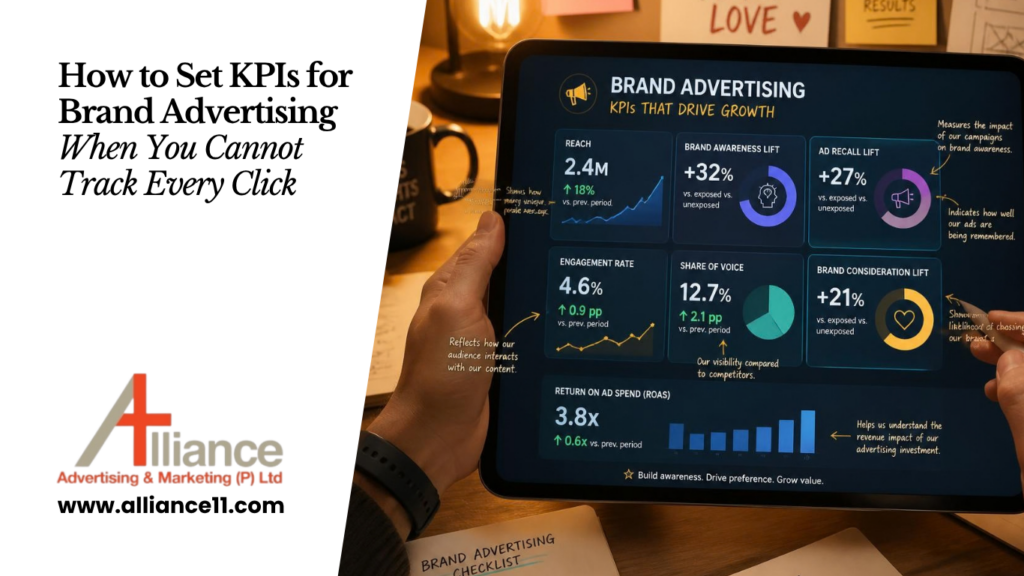
Brand lift studies: Digital platforms including YouTube, Meta, and JioHotstar offer brand lift measurement as a standard campaign measurement option. These studies survey consumers who were exposed to the campaign versus a matched control group that was not exposed, measuring awareness, consideration, preference, and purchase intent differences between the two groups. For digital brand campaigns, brand lift studies are the most accessible and most rigorous direct measure of brand advertising effectiveness available.
Tier 3 — Behavioural Proxy KPIs
These measure consumer behaviours that can be tracked through digital signals and that are strongly correlated with brand advertising impact, even when the direct causal chain cannot be fully established.
Branded search volume: The volume of searches for the brand name or brand-specific terms on Google during and after the campaign period. Branded search is one of the most reliable indirect measures of brand advertising impact available because it reflects consumers who have been sufficiently motivated by brand communication to actively seek out more information. Television campaigns, radio campaigns, outdoor advertising, and quality brand content all produce measurable uplifts in branded search volume that are trackable through Google Search Console and Google Keyword Planner.
Measuring branded search uplift requires a pre-campaign baseline — the average weekly branded search volume in the weeks before the campaign launches — and a comparison with weekly search volume during and after the campaign flight. The difference, controlling for seasonal effects and other campaign activity, represents the brand advertising’s contribution to search intent.
Direct traffic uplift: The volume of direct website visits — consumers who type the brand’s URL directly into their browser or navigate directly from a bookmark — during and after the campaign period. Direct traffic is a proxy for brand awareness and positive brand disposition: consumers who navigate directly to a brand’s website have formed sufficient familiarity and intent to bypass search entirely. Increases in direct traffic during brand advertising flights that cannot be explained by other campaign activity are a reliable indirect measure of brand impact.
Category entry point ownership: The proportion of consumers who mention the brand first, or include it in their consideration set, when prompted with a specific purchase occasion — “which brand would you consider if you were buying a water purifier for your family?” Category entry point measurement requires survey-based research rather than digital tracking, but it is one of the most commercially predictive metrics available for brand advertising because it directly measures the mental availability that drives purchase.
Share of search: The brand’s proportion of total branded search volume within its category — the brand’s search volume divided by the total search volume for all brands in the category. Share of search is both a measure of current brand salience and a leading indicator of future market share. Research across multiple categories has found that share of search predicts market share changes with a lead time of several months, making it a valuable early signal of whether brand advertising is building the mental availability that will drive future commercial performance.
Social mention volume and sentiment: The volume and sentiment of organic social media mentions of the brand during and after the campaign period. While not a direct measure of brand advertising effectiveness, changes in organic social mention patterns — particularly sentiment shifts and the proportion of positive versus negative mentions — reflect changes in how the brand is being discussed and perceived that correlate with brand advertising impact in active campaigns.
Tier 4 — Commercial Outcome KPIs
These measure the ultimate commercial impact of brand advertising — the changes in business performance that sustained brand investment produces over time. They are the most important KPIs in the framework and the ones most often missing from brand advertising measurement because their connection to specific campaign activity is hardest to establish.
Market share: The brand’s proportion of total category sales, measured through retail audit data, e-commerce share data, or survey-based purchase tracking. Market share is the ultimate measure of whether brand building is working — a brand that is successfully building mental availability and positive associations among its target audience will, over time, win a larger share of category purchases.
Market share is a lagging indicator — it responds to sustained brand investment over quarters and years rather than to individual campaigns. But tracking market share trends alongside brand advertising investment is essential for understanding whether the brand building programme is producing commercial return over the time horizon that is relevant to brand advertising.
Revenue and volume in brand advertising periods versus non-advertising periods: Comparing sales performance in periods when significant brand advertising is running versus matched periods when it is not — controlling for pricing, distribution, and competitive variables — provides a baseline estimate of brand advertising’s contribution to commercial performance. This is a simplified version of Marketing Mix Modelling and is achievable for most brands without the full MMM infrastructure.
Price premium maintenance: The brand’s ability to sustain pricing above the category average or above specific competitive alternatives. Brand equity is commercially most tangible in a brand’s ability to command a price premium — consumers who have strong positive associations with a brand are willing to pay more for it than for undifferentiated alternatives. Tracking the price premium the brand commands over time, and correlating it with brand advertising investment levels, measures one of the most direct commercial manifestations of brand equity.
Customer lifetime value of brand-aware versus non-brand-aware acquirees: Comparing the long-term value — repeat purchase rates, average order values, retention rates — of customers who were acquired following exposure to brand advertising versus customers acquired through performance marketing alone, provides a direct measure of the customer quality difference that brand advertising investment produces.
New customer acquisition rate: The rate at which the brand is acquiring first-time buyers, measured over rolling quarterly periods. New customer acquisition requires brand awareness and consideration among consumers who have not yet purchased — which is exactly what brand advertising builds. Sustained growth in new customer acquisition rates, correlated with brand advertising investment, is a strong commercial signal of brand advertising return.
Marketing Mix Modelling: The Most Rigorous Commercial KPI Framework
For Indian brands spending above ₹15–20 crore annually on media across multiple channels, Marketing Mix Modelling is the most rigorous approach available for establishing the commercial contribution of brand advertising alongside all other marketing and business variables.
MMM uses statistical analysis of historical data — typically two to three years of weekly or monthly data on sales, media spend by channel, pricing, distribution, promotions, competitive activity, and economic conditions — to estimate the causal contribution of each input to commercial outcomes. Unlike digital attribution, which can only measure touchpoints that produce trackable digital interactions, MMM captures the contribution of television, radio, print, and outdoor advertising through the statistical relationship between media investment in these channels and subsequent sales performance.
AI-enhanced MMM, which uses machine learning to identify non-linear relationships and interaction effects that traditional statistical models miss, produces materially more accurate estimates of channel contribution than traditional MMM approaches — particularly for capturing the interaction effects between brand advertising and performance marketing, which is one of the most commercially important and most commonly underestimated dimensions of marketing mix analysis.
The specific value of MMM for brand advertising measurement is that it produces a single, commercially grounded estimate of return on brand advertising investment that is comparable across channels and that integrates the brand advertising KPIs from Tiers 1 through 3 into a commercial outcome framework. Brand awareness improvements, consideration score gains, and branded search uplifts are inputs to the MMM model that help explain the statistical relationships between media investment and sales. The MMM output — revenue contribution by channel, elasticity estimates, and optimised budget allocation recommendations — is the commercial KPI that closes the measurement loop.
Setting KPI Targets: The Practical Framework
Having defined what to measure, the question is what targets to set. Target-setting for brand advertising KPIs requires three inputs.
Category benchmarks: What are typical brand awareness levels, consideration rates, and preference scores for brands at similar stages of development in this category? Category benchmarks contextualise a brand’s current performance and provide a realistic range for what sustained brand advertising can achieve.
Historical performance baselines: What were the brand’s awareness, consideration, and preference scores before the current campaign? The baseline establishes the starting point from which improvement is measured and the contribution of the current campaign can be isolated from secular trends.
Campaign investment and expected contribution: What level of reach and frequency does the planned campaign deliver, and what change in brand metrics would be expected from this level of investment based on prior campaign performance or category norms? This expectation sets the standard against which actual performance is evaluated.
A practical target-setting approach for a mid-sized Indian consumer brand running a significant brand advertising campaign might look like this:
Delivery targets:
- Reach 45% of target audience with minimum 3 exposures
- Deliver 250 TRPs in priority markets
- 70% viewability for digital video placements
Brand response targets:
- Aided brand awareness: increase from 62% to 68% among target audience in campaign markets
- Brand consideration: increase from 31% to 36% among aware consumers
- Ad recall: minimum 25% spontaneous recall among exposed audience
- Message takeout: minimum 60% accurate description of intended message among those who recall the ad
Behavioural proxy targets:
- Branded search volume: minimum 20% uplift versus pre-campaign baseline during campaign flight
- Direct traffic: minimum 15% uplift in campaign markets versus control markets
- Share of search: maintain or improve relative to category average
Commercial outcome targets:
- New customer acquisition rate: 10% improvement versus same period prior year in campaign markets
- Price premium maintenance: sustain current premium of X% above category average
- Market share: maintain or grow in priority markets over the campaign quarter
The Measurement Infrastructure Required
Setting these KPIs is only useful if the measurement infrastructure to track them is in place before the campaign launches.
Brand tracking research: A continuous or wave-based brand health survey among the target audience, measuring awareness, consideration, preference, and message metrics before and after the campaign. This can be conducted through research partners at a range of budget points — from simple dipstick surveys to comprehensive brand health trackers — depending on the scale of the investment being measured.
Google Search Console access: Already available to most brands with a website, Search Console provides branded search volume data at the weekly level that enables branded search uplift tracking before, during, and after the campaign.
Unified analytics dashboard: A single view of digital performance metrics — direct traffic, organic traffic, branded search volume, conversion rates — that allows the correlation between brand advertising activity and digital behaviour to be observed in near real time.
Control market design: For brands running campaigns in specific geographic markets, pre-defining matched control markets — markets with similar category dynamics that will not receive the brand advertising — provides the comparison baseline needed to isolate campaign effects from secular trends.
Sales data access: Weekly or monthly sales data by market, by channel, and by customer segment that can be compared across advertising and non-advertising periods and that feeds into MMM analysis over time.
The Honest Limitations
A comprehensive brand advertising KPI framework, properly implemented, will measure more of what brand advertising does than the delivery-only metrics that most Indian brand campaigns currently track. It will not measure everything.
Some brand advertising effects — the cultural presence that builds over decades, the word-of-mouth that a memorable campaign generates through WhatsApp and social sharing, the halo effect on employee morale and trade relationships — will remain outside any practical measurement framework. Some effects will be too small to measure reliably at the sample sizes affordable for most brands. And the interaction effects between brand advertising and the full range of marketing and business variables will always be incompletely modelled.
The appropriate response to these limitations is not to abandon measurement but to be honest about what the available measurement can and cannot tell you — and to ensure that the limitation of measurement does not become a de facto argument against investment in channels whose effects are harder to see.
The most expensive measurement failure for Indian brands is not imperfect measurement of brand advertising effects. It is the absence of any measurement of brand advertising effects — which, in a reporting environment that measures digital performance rigorously, systematically devalues the brand advertising that makes digital performance possible.
Conclusion
Brand advertising cannot be measured like performance marketing. Accepting this is not an admission of failure. It is the starting point for building a measurement framework that is actually appropriate to what brand advertising does and what it is trying to achieve.
The KPI framework described in this post — delivery, brand response, behavioural proxy, and commercial outcome — measures brand advertising across the full range of effects it produces, over the time horizons on which those effects operate, with measurement approaches that are matched to the specific mechanism through which brand advertising creates commercial value.
Indian brands that implement this framework will not achieve perfect measurement of brand advertising return. No framework does. But they will achieve something more valuable than imperfect measurement: an honest, multi-dimensional view of whether their brand advertising is working — and the specific, actionable information required to make it work better.
At Alliance, we help Indian brands build measurement frameworks for their media investment that are rigorous, commercially grounded, and appropriate to what each channel is actually doing in the marketing mix. If your current brand advertising measurement begins and ends with reach and GRPs — or if the absence of trackable conversion data is creating internal pressure to cut brand advertising in favour of performance channels — that is a conversation worth having before the next planning cycle commits the budget.