
The Number Nobody Talks About Openly
There is a number that makes most marketing heads uncomfortable when they hear it.
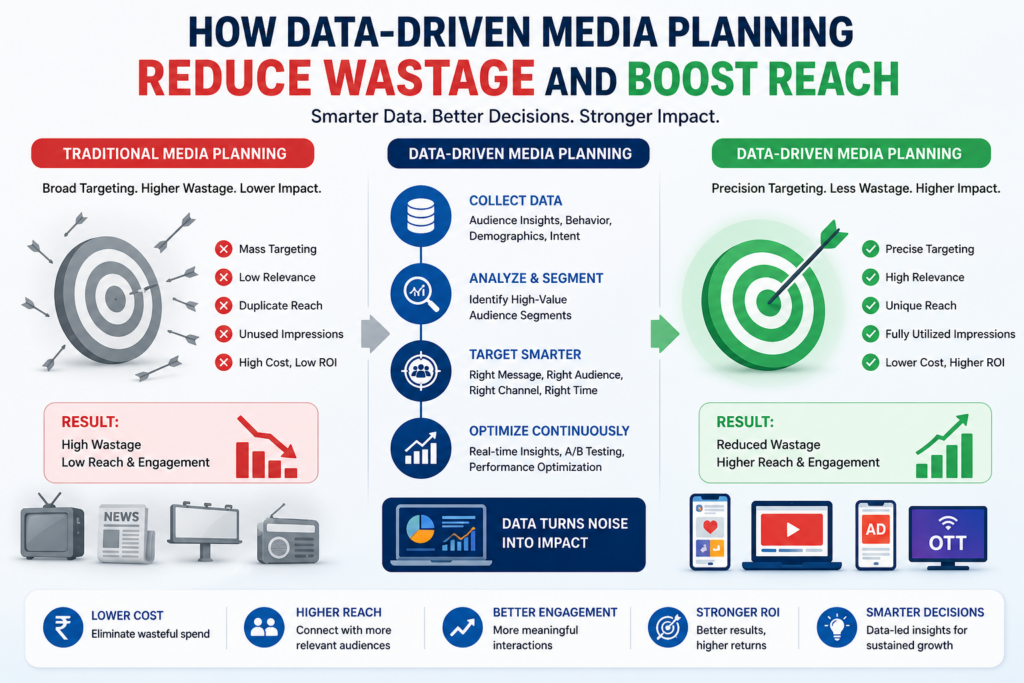
Research consistently suggests that between 20% and 40% of a typical media budget is wasted — spent reaching people who will never buy the product, in contexts where the message has no chance of landing, at times when the audience simply is not paying attention. On a ₹5 crore annual media budget, that is potentially ₹1–2 crore doing nothing useful every single year. On a ₹50 crore budget, you do the math.
What makes this especially uncomfortable is not the number itself. It is the quiet acceptance of it. For most of the history of advertising, this level of wastage was simply the cost of doing business. Television reached millions of people, and if a large chunk of them had no interest in your product — that was the price of scale. Print went to subscribers who may or may not have been in-market. Outdoor went to whoever drove past. You bought reach in large, imprecise units and hoped enough of the right people were inside them.
That world is fundamentally different now. The data available to media planners today — about who is paying attention, what they are interested in, when they are most receptive, and how close they are to making a purchase decision — would have been extraordinary just ten years ago. Search data alone can tell you, almost in real time, when a population of consumers starts thinking about buying something. Programmatic platforms can filter impressions by dozens of audience attributes simultaneously. Attribution modelling can trace the path from ad exposure to purchase across multiple touchpoints.
The question is no longer whether the data exists to make better decisions. It does. The question is whether your media plan is actually built around it — or whether you are still running last year’s plan with this year’s logo.
This post is about what genuinely data-driven media planning looks like in practice: where the biggest wastage comes from, how data addresses each type, how it also boosts effective reach (which is a different problem from reducing waste), and what specific things Indian brands should be thinking about right now.
What Media Wastage Actually Means — Four Types Worth Knowing
Before getting into solutions, it is worth being specific about what wastage means — because it takes different forms, and each requires a different fix.
1. Audience wastage
This is the most obvious kind: your ad for a premium home water purifier reaches someone who lives in a rented single room and is nowhere near a purchase decision. Every impression is a sunk cost. Not because reaching that person is inherently wrong — sometimes broad reach is part of the strategy — but because when it is unintentional and uncontrolled, it is just leakage.
Audience wastage is particularly high in traditional media, where targeting is blunt by nature. A prime-time television spot reaches whoever happens to be watching, and while good channel selection helps, it is never precise. In digital media, audience wastage should theoretically be lower — but poorly defined targeting parameters can actually make it worse, because you are now spending precisely on the wrong people at scale.
2. Contextual wastage
Subtler but equally damaging. Your brand appears in a content environment that is actively hostile to the message. A premium jewellery brand appearing next to discount coupon content. A children’s nutrition product placed in late-night entertainment programming. A financial services brand appearing on pages that rank for ‘how to avoid debt.’
The impression was technically delivered. But the context undermined it — or at best, rendered it irrelevant. Brand safety tools in digital media have improved significantly, but contextual suitability goes beyond avoiding harmful content. It means actively placing messages in environments where they are genuinely relevant and where the audience is in the right state of mind.
3. Timing wastage
The one most planners underestimate. Your ad runs at full weight during periods when your category is completely out of mind. An air conditioner brand spending heavily in November and December. A wedding jewellery brand running its biggest campaign in February, months before the main wedding season. A back-to-school product advertising in the middle of summer holidays.
The audience technically sees the ad. But they are not thinking about buying, which means the message has to work much harder to create any durable effect — and most of the time, it does not. Timing-aligned campaigns consistently outperform even well-targeted but poorly-timed ones.
4. Frequency wastage
The easiest to spot in hindsight but hardest to catch in real time. The same person sees your ad seventeen times in a week. The first few exposures build awareness and begin to shift consideration. The next dozen do increasingly little — and in digital channels, where consumers are acutely aware of being targeted, they often actively damage brand perception.
In a multi-channel environment, frequency wastage is deceptively easy to create accidentally. A consumer might see your TV ad four times, your YouTube pre-roll three times, your Instagram story twice, and your display banner six times in a single week — all from separate channel-level buying decisions that looked reasonable individually but added up to serious over-exposure collectively.
What ‘Data-Driven’ Really Means in Practice
The phrase gets used so often it has started to lose meaning. Every agency claims to be data-driven. The PowerPoint decks all have charts in them. But there is a significant difference between having access to data and actually using it to make better decisions.
Genuine data-driven media planning means making channel selection, timing, targeting, budget allocation, and optimisation decisions based on evidence — and updating those decisions as new evidence comes in. That sounds obvious. But consider how many media plans are still built primarily from the previous year’s plan, with minor adjustments for budget changes. If last year’s plan had structural wastage built into it, this year’s does too — just slightly modified.
The real test of whether a planning process is truly data-driven is not whether data appears in the plan. It is whether the data would have led to different decisions than intuition or habit would have produced. If data always confirms what the planner already thought, something is wrong — either with the data, the analysis, or the willingness to act on uncomfortable findings.
The real test of data-driven planning is whether the data leads to decisions that intuition alone would not have made.
Data-driven planning also does not mean optimising purely for what is measurable. One of the most common distortions in digital media is over-weighting channels and activities that are easy to attribute at the expense of those that are harder to measure but no less important. Brand-building on television is harder to connect to a direct sale than a paid search click — but that does not mean it is worth less. A mature data-driven approach holds both truths simultaneously and plans accordingly.
The Data Inputs That Actually Matter
Meaningful data-driven planning draws on several distinct streams of information. Understanding what each one tells you — and what its limitations are — is the foundation of good planning practice.
First-party data is what your own brand knows about its customers: purchase history, website behaviour, app usage, CRM records, loyalty programme data. This is the most valuable data you have, and it is almost always under-used in media planning. Your best customers are a goldmine of insight — not just as an audience to retain, but as a model for finding new people who look like them. Lookalike modelling built on clean first-party data consistently outperforms generic demographic targeting.
Search intent data is one of the cleanest signals available in media planning. When consumers search for category keywords, they are telling you directly that they are thinking about a purchase. Google Trends data, keyword planning tools, and platform search data can reveal when intent peaks for your category, where it peaks geographically, and how it relates to external events — seasons, cricket matches, festive periods. A media plan calibrated to these intent cycles will almost always outperform one that is not.
Category and competitive intelligence tells you what your competitors are spending, where they are spending it, and what they are saying. TAM, BARC, FICCI-EY reports, and platform-level intelligence all contribute to a picture of the competitive media environment. Understanding this context is essential for identifying where your share of voice is strong, where it is weak, and where there are opportunities to own a channel or a moment that competitors are ignoring.
Audience behavioural data from platforms and data management platforms (DMPs) tells you about the content habits, platform preferences, and demographic profiles of the audiences you are trying to reach. More importantly, when combined with your own customer data, it can reveal the audiences you are accidentally reaching — people who look like your target in aggregate but behave very differently.
Historical campaign performance data is the most overlooked input in many planning processes. If you have been running campaigns for several years, you have a rich dataset of what worked, what did not, which channels drove outcomes, and which channels drove impressions that looked like outcomes but were not. That data should be systematically feeding the next plan — not sitting in a reporting folder that nobody opens after the quarter closes.
Third-party research and panel data from sources like BARC India (for television), IRS (for print), RAM (for radio), and platform measurement tools fills in the gaps that your own data cannot cover. Reach estimates, frequency distributions, audience composition — these inputs allow planners to model the combined effect of a multi-channel plan before spending begins, rather than discovering the outcome only after the budget is gone.
Seven Ways Data Reduces Wastage in Real Campaigns
1. Audience definition that goes beyond demographics
Age and gender targeting was the foundation of media planning for decades — and it remains relevant as a starting point. But it is a genuinely blunt instrument. Two people who are both 32-year-old women living in Bengaluru can have completely different relationships with a category, different purchase readiness, and different brand perceptions. Treating them identically in a media plan is a choice to accept audience wastage by default.
Data-driven planning supplements demographic targeting with behavioural and psychographic layers — interests derived from content consumption, purchase signals from e-commerce data, in-market intent from search behaviour, and life-stage indicators from social and platform data. The result is a target audience definition that is meaningfully more precise, which means a higher proportion of impressions reach people who are genuinely relevant to the brand.
This is most powerful in digital channels, where these targeting layers can be applied in real time. But the thinking is applicable to traditional media too. Choosing between two television programmes with similar aggregate reach becomes a much more informed decision when you have data on the actual audience composition of each — not just the TAM rating, but the category purchasing behaviour of each programme’s viewers.
2. Timing campaigns to match intent cycles
One of the consistently highest-return interventions in media planning is simply shifting budget from low-intent periods to high-intent periods within the same total investment. The spend does not change. The proportion of it that reaches an audience actively thinking about your category goes up dramatically.
Search data makes these intent cycles visible with remarkable clarity. For consumer durables, intent spikes around Diwali, around summer (for cooling products), and around the period when new housing projects near possession. For financial products, the tax season creates a distinct and predictable intent window. For education products, admission cycles are unmistakable in the data. For FMCG, the patterns around festivals and around monsoon vary significantly by sub-category.
Planning campaigns around these intent cycles rather than simply running at a constant weight throughout the year is one of the most straightforward applications of data available to any brand — and one of the highest-impact ones. It requires no new technology and no new partners. It requires only the willingness to look at the data before writing the plan rather than after it.
3. Programmatic buying with genuine audience targeting
Programmatic advertising gets both over-credited and under-used. Over-credited because the word ‘programmatic’ is sometimes treated as synonymous with ‘good digital buying’ — which it absolutely is not, if the targeting parameters are poorly defined and the audience segments are generic. Under-used because many brands still treat programmatic as a cheap reach extension rather than as a precision instrument.
When programmatic is configured properly — with well-defined first-party and lookalike audience segments, clean exclusion lists to filter irrelevant impressions, frequency caps to prevent over-exposure, viewability standards to ensure the ad is actually seen, and brand safety filters to control context — it becomes one of the most efficient media channels available. You are buying specific audiences at a specific moment of receptivity, not just buying cheap inventory.
The critical distinction is between programmatic as a buying mechanism and programmatic as a targeting strategy. Poorly configured programmatic campaigns produce very high impression volumes at very low CPMs and very poor outcomes. The cost-per-impression looks efficient. The cost-per-result is often catastrophic. The difference between those two outcomes is almost entirely in the quality of the audience definition and the discipline of the setup.
4. Cross-channel frequency management
Over-frequency is one of the most common and most preventable forms of media wastage. In a fragmented multi-channel environment, it is also alarmingly easy to create by accident.
Managing frequency intelligently requires looking at the media plan holistically rather than channel by channel. This is where integrated planning — where digital and traditional channels are planned together in a single view rather than in separate departmental silos — creates real and measurable advantage. When a single planner or planning team can see the combined reach and frequency picture across television, digital video, social, display, and audio, they can cap repetition, deprioritise channels that are adding only frequency rather than incremental reach, and reallocate budget toward genuinely new audiences.
Practically, this means using unified reach planning tools that can model cross-channel frequency distributions before buying, setting explicit frequency caps on digital channels that account for the television GRPs a consumer is also receiving, and monitoring combined frequency in real time during campaign flight rather than discovering the over-exposure problem only in the post-campaign report.
5. Creative-audience matching
A dimension of wastage that gets far less attention than it deserves. Running the wrong creative to the right audience is a form of wastage — not as obvious as reaching the wrong people, but equally real in its impact on campaign effectiveness. A product benefit that matters deeply to one audience segment may be completely irrelevant to another, even if both segments are technically part of the target.
Data enables creative-audience matching in ways that were operationally impossible even five years ago. Dynamic creative optimisation (DCO) platforms can serve different creative variants to different audience segments simultaneously — same campaign, different messages, all within the same budget. The data that defines the audience segments also informs which creative message is most likely to resonate with each. The result is campaigns that feel more relevant, drive stronger engagement, and convert at higher rates — all from the same media investment.
6. Geographic precision and regional allocation
India is not one market. It never has been. But many national media plans are built as if it were — with budgets allocated largely proportionally to population or television viewership, rather than to the actual distribution of purchase intent or competitive opportunity.
Geographic data — from search trends, from e-commerce penetration, from BARC regional data, from retail sell-out information — can reveal where your category’s genuine demand is concentrated versus where it is diffuse. Sometimes the highest-spending regions are not the highest-opportunity ones. Sometimes there are significant pockets of intent in tier-2 or tier-3 cities that are being systematically under-served because the national plan does not reach down to that level of granularity.
Regional reallocation based on intent data is often one of the quickest wins available to a brand that has been running national plans without regional precision. The total budget does not change. The concentration of it in genuinely high-opportunity geographies often produces a measurable lift in market share in those regions within a single campaign cycle.
7. Post-campaign analysis as a forward input
This is where most brands lose the most value from their data, and it is worth being direct about why. Campaigns run. Reports are produced. Reports are reviewed in a post-campaign debrief. And then the planning cycle starts again, largely from the same starting point as the previous year.
A genuinely data-driven approach treats every campaign as the primary evidence base for the next one. Which audience segments showed the strongest conversion rates? Which creative formats held attention? Which channels drove the lowest cost-per-outcome at what point in the funnel? Which dayparts performed? Which regions over-indexed? Which categories of content placement delivered the strongest brand recall?
When these questions are systematically answered and the answers fed into the next planning cycle, the plan improves in ways that no amount of additional data access can replicate. You are learning specifically what works for your brand, your category, your competitive context — not just applying general industry benchmarks. Over three to four years of this kind of compounding, a brand’s media efficiency typically improves in ways that are genuinely hard for competitors to replicate, because the insight is proprietary.
Boosting Reach: The Other Side of the Equation
Reducing wastage and boosting effective reach are related but distinct problems. Reducing wastage means ensuring that the impressions you are already buying are going to the right people in the right contexts at the right times. Boosting reach means finding more of the right people — particularly those who are currently not being reached by your plan at all.
This distinction matters because it is entirely possible to run a highly efficient, low-wastage campaign that is also significantly under-reaching its target audience. Efficiency without sufficient reach will not build a brand. The goal is not just to waste less — it is to reach more of the people who actually matter, with less wasted on the people who do not.
Reach extension through channel diversification
In the Indian market, there are consistent and significant pockets of target audience that are not reached by the channels most brands default to. Heavy television viewers who are light digital users. Heavy short-video consumers who do not watch premium OTT content. Regional language print readers who are not on English-language digital platforms. Podcast listeners who do not watch television.
Audience data can identify which segments of your target are being missed by your current channel mix and which channels or formats would extend reach into those segments most efficiently. This is particularly valuable for brands that have been running the same channel mix for several years — the combination that was optimal three years ago may now be missing a substantial and growing segment of the target audience.
Incremental reach modelling
Not all channels add reach equally. The tenth GRP on a channel you are already heavily invested in adds far less incremental reach than the first GRP on a channel your audience also consumes but you are not present in. Incremental reach modelling — which estimates the additional, unduplicated reach each additional investment in a channel generates — is one of the most useful tools available to a planner trying to maximise the proportion of the target audience reached within a fixed budget.
In practice, this analysis often reveals that the media plan is over-invested in channels where additional spend is mainly adding frequency to already-reached consumers, and under-invested in channels that would add genuinely new, unduplicated reach at a reasonable cost. Rebalancing accordingly — often without any increase in total budget — can increase effective reach by 15–25% in a single planning cycle.
Audiences that data identifies but intuition misses
One of the most consistent findings from serious audience analysis is that the actual buyers of a product often look different from the assumed target audience. A home appliance brand assumes its buyers are homeowners aged 35–55 — and that is true of the majority. But data from sales records and CRM analysis might reveal a significant and growing segment of younger buyers, or a segment of purchasers in tier-2 cities that the plan has never addressed, or a segment of buyers who are reached primarily through category content on YouTube rather than through any of the channels currently in the plan.
These data-identified segments represent genuine reach opportunity. They are not being reached because they were not in the planning brief — not because they cannot be reached. Building them into the media plan adds reach to audiences that are already demonstrating purchase intent, often at lower cost than the primary target because they are less contested by competitors.
The India Dimension: Why This Matters More Here
The Indian media market has several characteristics that make data-driven planning both more important and more complex than in many other markets. Understanding these specifics is essential for applying general principles effectively.
Language and regional fragmentation
India has 22 officially recognised languages, hundreds of dialects, and media consumption that is profoundly shaped by linguistic identity. A campaign designed for a Hindi-speaking audience in UP will resonate very differently with a Tamil-speaking audience in Chennai, even if the demographic profile is identical. Audience behaviour on Meta in Maharashtra is measurably different from audience behaviour in West Bengal. Content preferences, platform usage, influencer trust, and purchase triggers all vary significantly by language and region.
Data-driven planning in India must account for this fragmentation. A national plan that does not disaggregate by language and region is averaging across too much variation to be genuinely efficient in any single market. The brands that are winning regional market share in India right now are typically the ones that have built the discipline to plan at a regional level, with regional audience data informing channel mix and creative decisions in each geography.
The tier-2 and tier-3 digital audience
One of the most significant structural shifts in Indian digital media over the last four years is the growth of digital consumption in smaller cities and towns. The next 300 million internet users in India are predominantly from tier-2 and tier-3 cities — and they are already on the platforms. They are watching YouTube in regional languages. They are on Facebook. They are on short-video platforms. They are searching on Google, often in their regional language.
Most brand media plans have not fully adapted to this. Digital plans are still often disproportionately weighted toward metro audiences, because the metro audience is more familiar and the data is more complete. But for most FMCG, consumer durables, and financial services brands, a significant and growing proportion of actual volume and actual growth is coming from these smaller geographies. The data exists to plan for these audiences effectively. The gap is in the planning discipline to act on it.
IPL and cricket event cycles
Cricket — and IPL in particular — creates extraordinary spikes in both media attention and media costs that have no equivalent in most other markets. During an IPL season, premium television inventory is effectively unavailable at rational prices for brands that have not committed early. Digital video CPMs spike as inventory tightens. Consumer attention is more concentrated around a single property than at almost any other point in the year.
Data-driven planning around IPL requires a different kind of discipline than regular planning. It means modelling the actual reach and frequency contribution of IPL inventory against its cost premium — and being honest about whether that premium is justified for your specific brand and category. It also means planning the pre-IPL and post-IPL periods as high-value, lower-cost windows that most brands under-invest in because they are focused on the event itself.
For brands that are genuinely in-market with purchase intent concentrated around cricket season — electronics, appliances, beverages, snacks, financial products — the IPL premium is often justified. For brands where the connection is weaker, the same budget allocated across the surrounding period can deliver significantly better efficiency.
Festive season planning
The October-November festive period — Navratri through Diwali and into Dhanteras — is the single highest-intent purchase window for most consumer categories in India. Media prices reflect this, with inventory costs spiking significantly in the weeks immediately before Diwali. Brands that have historically committed early and used data to precisely target in-market consumers during this window consistently outperform those that entered the market at peak cost with broad targeting.
The specific insight from data in festive planning is often about timing within the season. Broad awareness is built most efficiently in the weeks before the peak. Conversion-focused activity, with tighter audience targeting around demonstrated in-market signals, is most efficient in the ten days immediately before Diwali. Brands that treat the entire festive period as a single undifferentiated flight — the same creative, the same targeting, the same channels throughout — typically spend more and convert less than those who shift strategy in response to where consumers are in their purchase journey at each point in the season.
Tools and Technologies Worth Knowing About
The data-driven planning ecosystem has matured significantly, and there are now practical tools available to Indian brands at most budget levels. Here is a clear-eyed view of what is genuinely useful and where the limitations lie.
Google Trends and Keyword Planner remain two of the most accessible and underused tools in media planning. Free, reliable, and India-specific, they provide category-level intent data that should be a standard input to every media plan. If your plan does not reflect the search intent patterns for your category, it is missing a significant data source at no cost.
BARC India is the television audience measurement system and the primary data source for TV planning in India. BARC data tells you not just the rating of a programme, but the audience profile — which is essential for understanding the actual wastage in your TV buy versus the aggregate reach number.
Meta Audience Insights and Google Audience Manager provide detailed data on the audiences available in each platform’s ecosystem, including overlap analysis that is essential for cross-channel frequency management. Used together, they can give a reasonable picture of the unduplicated reach across the two largest digital channels.
Demand-Side Platforms (DSPs) like DV360 (Google’s), The Trade Desk, and regional players enable programmatic buying with genuine audience targeting. The value of a DSP is directly proportional to the quality of the audience data fed into it — which is why first-party data integration is so important.
Marketing Mix Modelling (MMM) is the most rigorous tool available for understanding the actual contribution of each media channel to business outcomes, accounting for external factors like pricing, distribution, and competitive activity. It requires significant investment — in time, data, and analytical resource — but for brands spending above ₹10–15 crore annually on media, it typically pays for itself within one planning cycle through the improvements it enables in budget allocation.
Attribution platforms like AppsFlyer, Branch, and Adjust are essential for digital performance campaigns and provide touchpoint-level data on the consumer journey from ad exposure to conversion. Their limitation is that they measure within the digital funnel and cannot easily account for the influence of offline touchpoints — which is why they should be used as inputs to a broader planning view, not as the sole measure of campaign effectiveness.
What Good Data-Driven Planning Looks Like Day to Day
It is worth making this concrete. Data-driven planning is sometimes described in ways that make it sound like a transformation programme requiring new technology, new people, and a multi-year roadmap. That is sometimes true at scale. But at the level of an individual campaign, it is mostly a set of habits and questions that should be applied to every brief, every plan, and every campaign review.
Before a plan is written, the planner should be asking:
- What does search data tell us about when intent peaks for this category?
- Who are our actual buyers, and what does our own data tell us about how they differ from our assumed target?
- Which channels are over-indexed in our current mix relative to where our audience actually spends time?
- What did the last campaign tell us that we have not yet acted on?
- Where in the country is intent actually concentrated, and does our regional allocation reflect that?
During a campaign flight, the right questions are:
- Are actual delivery audiences matching the planned target profile?
- Is combined frequency across channels within acceptable bounds for each consumer segment?
- Which creative variants are outperforming, and should we be shifting budget toward them?
- Are there channels where marginal spend is adding frequency rather than reach?
After a campaign, the questions that feed the next plan are:
- Which audience segments drove the strongest business outcomes, and should our next target definition reflect that?
- Which channels delivered the best cost-per-outcome, and at what point did returns start diminishing?
- What did we learn about timing — were there periods where the same spend delivered noticeably better results?
- What would we do differently with the same budget if we were running this campaign again tomorrow?
These are not sophisticated analytical questions. They are the discipline of asking the right things consistently and building the answers into the next cycle. That consistency, applied over multiple years, is what separates media plans that compound in effectiveness from those that simply repeat.
The Honest Limits of Data
It would be misleading to suggest that data eliminates uncertainty from media planning. It does not, and it is important to be clear about that — both because it is true and because over-confidence in data leads to its own category of planning errors.
Data tells you what has happened. It gives you informed probabilities about what will happen under similar conditions. It does not account for the discontinuities that make marketing interesting and difficult — a competitor’s unexpected campaign launch, a cultural moment that reshapes category salience overnight, a platform algorithm change that invalidates your targeting model, a macroeconomic shift that changes consumer priorities across the board.
There is also a real risk of optimising too heavily for what is measurable at the expense of what matters. This is the attribution trap. Performance data is rich in digital channels and relatively sparse in traditional ones — which creates a systematic pressure to weight digital higher in the mix, because its contribution is easier to see. But brand-building on television, outdoor, and print creates effects that are real, valuable, and poorly captured by digital attribution models. A mature data-driven approach holds both truths simultaneously and resists the temptation to underinvest in what cannot be easily measured.
The attribution trap is real: what gets measured gets funded, even when what matters most is harder to measure.
Data also reflects the past, which means it can lead you astray in rapidly changing markets. The audience behaviour patterns that held true for the last three years may be disrupting right now, and the data will not tell you that until the disruption has already happened. Experienced human judgement — about where markets are heading, about emerging platforms, about shifts in consumer sentiment — remains irreplaceable even in the most data-rich planning environments.
The goal of data-driven planning, properly understood, is not certainty. It is continuous improvement. The planner who uses data well will be wrong less often than the one who does not, will know sooner when something is not working, and will have more time to adjust before the budget is gone. That is a meaningful advantage — but it is not omniscience.
Where Most Brands Are Leaving Money on the Table Right Now
Based on our experience planning media for Indian brands across categories for over 30 years, there are a handful of specific gaps that come up consistently — not as dramatic failures, but as quiet inefficiencies that compound over time.
Under-investment in first-party data infrastructure. Most brands have more customer data than they are using in their media plans. Purchase records, CRM data, website visitor data — all of it can inform better audience targeting and better measurement. The gap is usually not in the data itself but in the integration of that data with the media buying process. Bridging that gap is one of the highest-ROI investments a brand can make in its marketing capability.
Regional plans that are just proportionally scaled national plans. A media plan that distributes budget proportionally to population or television viewership, without disaggregating by regional intent data, is leaving significant efficiency gains on the table. The brands growing fastest in tier-2 India right now are almost universally those that have built regional precision into their planning.
Post-campaign reports that are not fed back into pre-campaign planning. This is structural, not a data problem. The insight from last quarter’s campaign is sitting in a file that the planner will not look at before writing next quarter’s plan. Creating a simple, structured habit of extracting and applying the key learnings from every campaign would improve planning quality for most brands within two to three cycles.
Frequency that is managed channel by channel rather than consumer by consumer. Each channel team — TV, digital, social, programmatic — manages frequency within their own channel. Nobody is managing combined frequency across all of them. The consumer does not experience your media plan by channel. They experience it as a total. Planning for that total exposure is not technically difficult. It requires only the coordination to do it.
Creative that is uniform across audience segments it should be tailoring. Data-driven media planning and data-driven creative execution are converging. The audience intelligence that informs your targeting should also inform your creative — which benefits to lead with for which segments, which formats and lengths work best for which contexts, which messages to test in which geographies. The brands using DCO effectively are seeing meaningful lifts in creative performance from the same media spend.
Conclusion
Media budgets are always constrained relative to ambitions. Every rupee that reaches the wrong person is a rupee that did not reach the right one. In a market as competitive and as complex as India, that gap between efficient and inefficient planning is often the difference between a brand that grows and one that stagnates — even when the total investment is identical.
The brands that are pulling ahead in their categories right now are typically not the ones spending more. They are the ones spending smarter — using the data that is now genuinely available to reduce structural wastage, reach more of the consumers who actually matter, and compound that advantage over time through systematic learning from every campaign they run.
The tools exist. The data exists. The methodology is established and proven. What remains is the planning discipline to apply it consistently — before the plan is written, while the campaign runs, and after it ends.
At Alliance, we have been planning media in India for over 30 years. The tools have changed dramatically in that time. The underlying discipline has not: understand your audience, place your message where they are paying attention, measure what actually matters, and keep improving. Data just allows us to do all of that with a precision that was genuinely not possible before. And that precision, applied consistently, makes a material difference to the efficiency and effectiveness of every campaign we plan.