Table of Contents
The question comes up in almost every marketing conversation in India right now. A brand manager sees a demo of ChatGPT producing a product description in seconds. A creative director reads about an agency using AI to generate hundreds of ad variants overnight. A CMO asks their team why they are still paying for copywriters when the AI can do it faster and cheaper.
The question is reasonable. The answer is more complicated than either the enthusiasts or the sceptics tend to acknowledge.
Yes, AI can write advertising copy. It can produce grammatically correct, structurally coherent, reasonably persuasive text across a wide range of formats — product descriptions, social media captions, email subject lines, Google ad copy, meta descriptions, campaign taglines — faster than any human writer and at a fraction of the cost. For certain applications, this is genuinely useful and commercially significant.
No, AI cannot do what the best advertising copy does. It cannot produce the unexpected creative idea that stops a consumer mid-scroll and makes them feel something. It cannot navigate the cultural nuance of writing in a way that feels authentically Indian — rooted in the specific linguistic texture, the cultural reference points, and the emotional register of a particular regional audience — rather than translating a global format into Indian language. It cannot replace the strategic thinking that determines not just what the copy says but what it is trying to achieve and why.
Understanding precisely where AI copywriting is useful and where it is not — in the specific context of Indian brand communication, which has characteristics and requirements that most global assessments of AI writing capability do not address — is what this post is about.
What AI Copywriting Tools Can Actually Do
Modern AI writing tools — the large language models that power ChatGPT, Claude, Gemini, and the specialised marketing tools built on top of these models — are capable of genuine, commercially useful output across several specific copywriting applications. Being specific about what these applications are is more useful than either dismissing or universally endorsing the technology.
High-Volume, Format-Driven Copy Production
The most clearly valuable application of AI in advertising copy is the production of high-volume, format-driven content where the creative parameters are well-defined and the primary challenge is output at scale rather than creative breakthrough.
Consider what a brand running a national e-commerce campaign in India needs: hundreds of Google Search ad copy variants across dozens of keyword groups, each with three headline variants and two description variants, each compliant with character limits, each relevant to the specific keyword intent. Dozens of product description variants for A/B testing on marketplace listings. Email subject line variants for different audience segments. Social media caption alternatives for a week of scheduled posts.
A human copywriter producing all of this output — at the required volume, within the required timeline, to the required specification — is doing highly repetitive, low-creative-complexity work that is a poor use of their skills and a significant cost to the brand. An AI tool producing the same output is doing exactly what it is best at: generating variations on a defined format at scale and speed that no human can match.
This is not a future capability. It is available now, and the brands that are using it for this specific application are seeing genuine productivity improvements in their content production workflows.
First-Draft Generation That Humans Then Refine
A second genuinely useful application is using AI to generate first drafts that human writers then refine, rather than treating AI as a replacement for the human writer entirely.
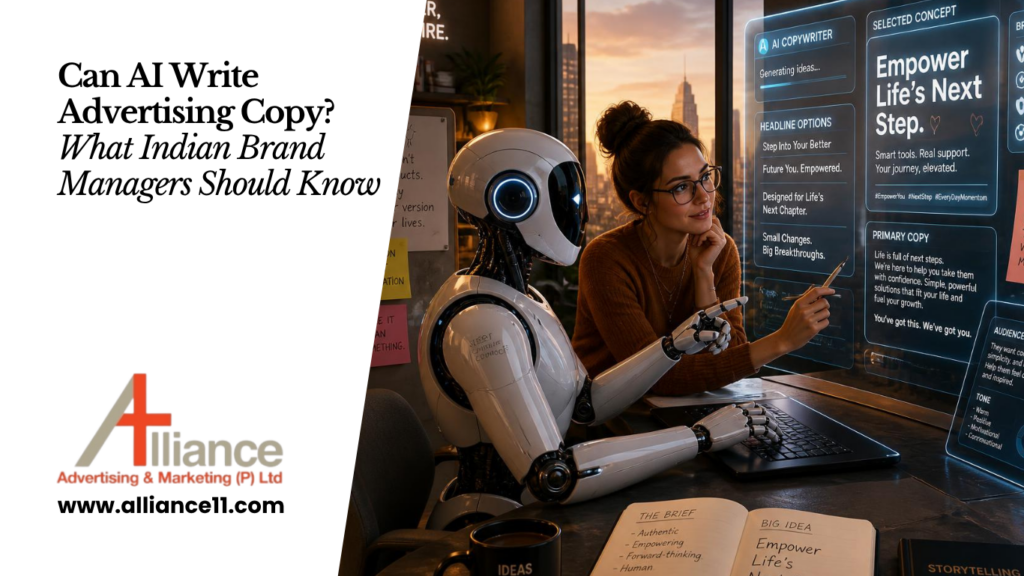
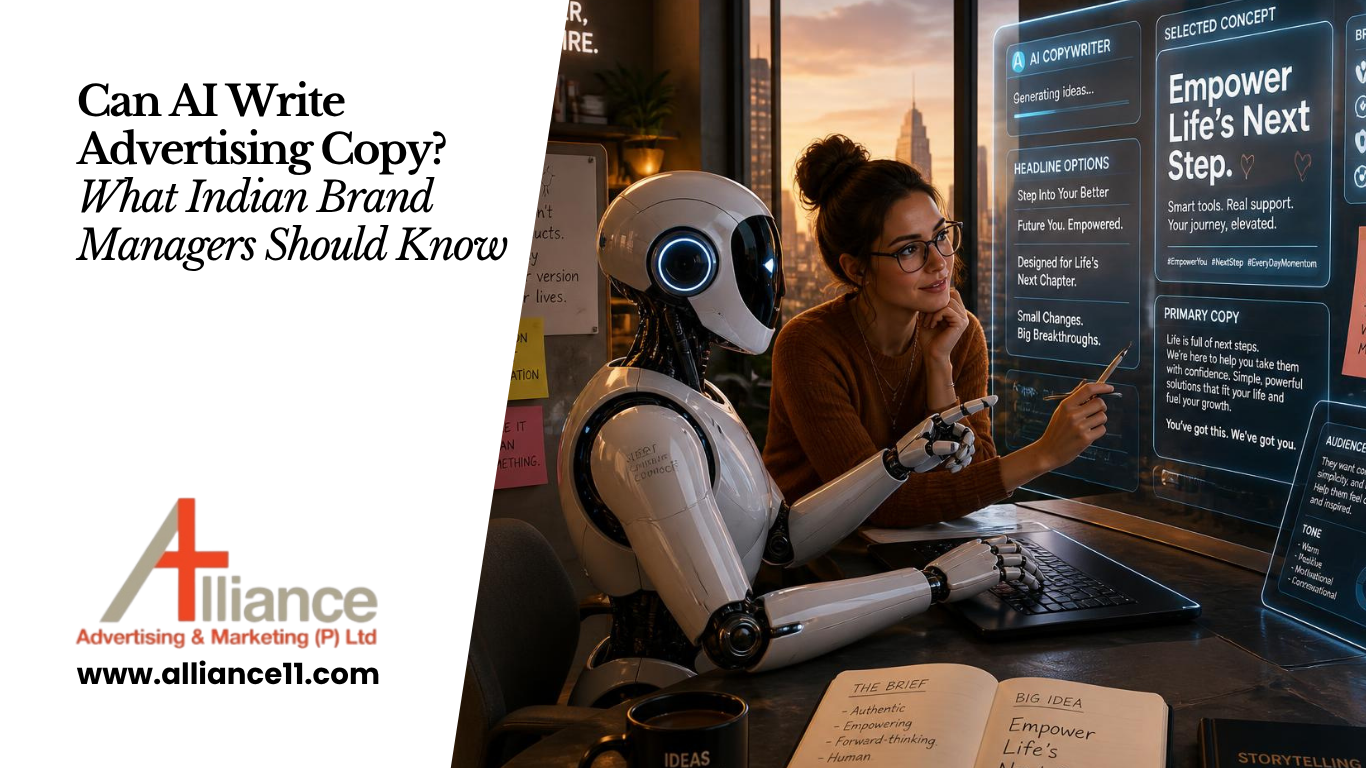
The creative process for advertising copy often involves a substantial amount of time on the blank page — generating options, exploring directions, writing and discarding before finding an approach worth developing. AI can compress this initial generation phase significantly, producing a range of directions quickly that a human writer can then evaluate, develop, and refine — starting from material rather than from nothing.
This is a workflow change, not a replacement. The human writer’s contribution shifts from generation to judgment and refinement — deciding which AI-generated directions are worth developing, identifying what is missing or wrong in each, and doing the work of taking a direction from serviceable to genuinely good. For many brands and agencies, this workflow produces better output in less time than the purely human process, because the AI handles the laborious generation phase and the human handles the judgment and craft phase.
Personalisation at Scale
Dynamic creative personalisation — serving different copy to different audience segments based on their characteristics, their stage in the purchase journey, or the context in which they are encountering the brand — is a capability that the combination of AI and modern advertising platforms now makes genuinely available at scale.
An AI system can generate copy variants calibrated to different audience profiles — different age groups, different regional markets, different product interests, different previous brand interactions — and the programmatic delivery system can serve the appropriate variant to each consumer. The result is advertising that feels more relevant to each individual consumer than a single, universal copy approach would.
For Indian brands, this personalisation capability has specific value in a market where the diversity of consumer contexts — linguistic, cultural, regional, economic — is high enough that a genuinely universal copy approach consistently under-serves most of the audiences it reaches.
SEO and Content Marketing at Consistent Volume
Content marketing — the regular production of blog posts, guides, FAQs, and explainer content that builds organic search visibility and demonstrates brand expertise — is valuable for most Indian brands but difficult to sustain at the volume that effective SEO requires, because human content production is resource-intensive and inconsistent in pace.
AI writing tools can support a more consistent content production cadence by handling the structural and informational dimensions of content — the basic organisation of a topic, the answering of common questions, the description of how something works — that a human writer or subject matter expert then enriches with genuine insight, original perspective, and the kind of authoritative detail that distinguishes genuinely useful content from generic filler.
Where AI Copywriting Falls Short — Specifically in India
Having been specific about what AI does well, it is equally important — and more important for strategic decision-making — to be specific about where AI-generated copy consistently falls short. And in the Indian context, several of these limitations are more pronounced than global assessments of AI writing capability typically acknowledge.
AI Does Not Understand India in the Way Indian Consumers Experience It
This is the most fundamental limitation of AI copywriting for Indian brands, and it deserves more attention than it typically receives.
AI language models are trained on vast amounts of text from the internet. The internet is not a neutral representation of human experience — it is disproportionately English-language, disproportionately Western, and disproportionately produced by a segment of the global population that does not resemble the Indian consumer in most commercially relevant categories.
When an AI model generates copy intended for an Indian audience, it is drawing on a representation of India that is partial, mediated, and often stereotypical — the India that appears in English-language online content, not the India that a Gujarati homemaker or a Tamil college student or a Punjabi small business owner actually inhabits and experiences.
The result is copy that is technically Indian — it uses Indian brand names, references Indian festivals, mentions Indian cities — but that lacks the texture of genuine cultural rootedness. It reads as copy about India rather than copy for India. The difference is subtle but commercially significant, because Indian consumers are sensitive to inauthenticity in brand communication in ways that a generation of increasingly sophisticated media consumption has developed.
For Hindi and regional language copy specifically, this limitation is acute. AI-generated Hindi copy tends to be grammatically correct but register-inappropriate — formal in contexts that call for warmth, literal in contexts that call for wordplay, Hindi-in-English-structure in ways that feel stilted to a native speaker. The colloquial, context-sensitive, register-aware quality of genuinely effective Hindi advertising — the kind of copy that a native speaker writes from inside the culture rather than translating toward it — is not consistently reproduced by current AI tools.
This is not a permanent limitation. AI models will improve, and models trained on richer, more diverse Indian language data will produce better regional language outputs. But in 2026, the gap between AI-generated regional language copy and human-written regional language copy is wide enough to matter commercially for most brands for whom regional authenticity is a purchase driver.
AI Cannot Generate Genuinely Original Creative Ideas
There is a distinction between copy and ideas that is easy to blur but important to maintain. Copy is the execution — the words that express an idea. Ideas are the creative concepts that determine what the copy is trying to communicate and why.
AI is producing better copy than it was two years ago. It is not producing better ideas. The large language models that power AI writing tools are extraordinarily good at pattern recognition and pattern reproduction — at generating text that resembles the advertising copy and creative executions it was trained on. They are not capable of the kind of genuinely original creative thinking that produces an unexpected metaphor, an arresting juxtaposition, a cultural observation that no one has articulated quite that way before.
The most memorable advertising copy in Indian brand history — the lines and campaigns that have become part of the cultural furniture, that consumers quote without remembering they are quoting advertising — was produced by creative intelligence working with genuine human insight about what the Indian consumer feels, wants, fears, and aspires to. This is not reproducible by a pattern-matching system, however sophisticated.
For brand campaigns where the creative idea is the commercial asset — where the campaign’s ability to build brand equity depends on its distinctiveness, its emotional resonance, and its cultural relevance — AI is not the right tool for generating the core creative concept. It may be a useful tool for generating execution variants once the human creative team has established the idea worth executing.
AI Copy Is Often Competent but Not Compelling
There is a quality of advertising copy — particularly for brand campaigns as opposed to direct response campaigns — where the difference between what gets produced and what is genuinely needed is the difference between technically adequate and genuinely excellent. Between copy that communicates the message and copy that makes the consumer feel something.
AI-generated copy, even at its best, tends to be competent rather than compelling. It covers the required ground. It hits the brief criteria. It avoids obvious errors. It is serviceable in a way that is genuinely useful for high-volume, performance-oriented content where “serviceable” is an adequate standard. It is not, in most cases, producing the unexpected turn of phrase, the precise word choice, the rhythm and cadence that make a piece of advertising copy genuinely affecting.
This matters more for some brands and some categories than for others. For a brand whose competitive position depends on premium perception, whose advertising needs to convey taste and sophistication, whose consumers make purchase decisions based significantly on how the brand makes them feel — copy that is competent rather than compelling is not adequate. For a brand running direct response e-commerce advertising where clarity and specificity drive conversion — AI-generated copy may be entirely adequate, and the volume and speed advantages may outweigh the quality ceiling.
AI Cannot Be Accountable for Brand Consistency Over Time
A brand’s voice — the accumulated consistency of how it communicates across every piece of copy, every campaign, every touchpoint, over years — is one of its most valuable assets. It is what allows a consumer to encounter a new brand communication and immediately recognise it as coming from a particular brand, even without seeing the logo.
Building and maintaining brand voice requires a combination of human judgment about what is on-brand and what is not, institutional memory about how the brand has communicated and why, and creative discipline that applies consistent principles across a wide range of specific copy tasks. AI tools can be prompted with brand voice guidelines, and they will produce copy that attempts to follow those guidelines — but they cannot exercise the nuanced judgment about what is genuinely on-brand that a writer who has been immersed in a brand for years can exercise.
This limitation is particularly relevant for long-term brand communication that needs to build cumulative equity over time, rather than for one-off campaign copy that is evaluated on its immediate performance.
The India-Specific Considerations That Most AI Copy Assessments Miss
Hindi and Regional Language Copy Requires More Than Translation
The temptation for Indian brands exploring AI copywriting is to use it for English copy and then translate the output into Hindi and regional languages — either through AI translation or through human translators working from AI-generated English copy. This approach consistently produces suboptimal regional language copy, for reasons that go beyond translation quality.
Effective Hindi advertising copy is not translated English. It is written from within the Hindi cultural and linguistic universe — using the idioms, the rhythm, the reference points, and the emotional register that are native to that universe, not translated toward it. “Sehat ke liye sahi choice” does not mean the same thing as “the right choice for health” translated into Hindi — it means something different, it lands differently, it resonates differently, because the words are chosen for their Hindi-language associations, not for their proximity to an English original.
AI tools that generate Hindi copy from English prompts, or that translate English AI copy into Hindi, are not producing Hindi copy. They are producing Hindi-language approximations of English copy. For brands where regional language authenticity is a commercial requirement — and for a very large proportion of the Indian market, it is — this distinction matters.
Regulatory and Sensitivity Complexity Is High in India
Indian advertising operates within a regulatory environment — ASCI guidelines, FSSAI restrictions, SEBI and IRDAI requirements for financial services, pharmaceutical advertising restrictions — that is complex, category-specific, and subject to interpretation. AI-generated copy does not reliably navigate this complexity. It may produce copy that violates category-specific regulations or that makes claims that, while commercially appealing, are not permissible under the relevant regulatory framework.
Beyond regulatory compliance, the cultural sensitivity landscape in Indian advertising is complex in ways that an AI system trained primarily on Western content does not reliably navigate. What is inoffensive in one regional market may be offensive in another. What is an acceptable cultural reference in one category may be inappropriate in a different context. The judgment required to navigate these sensitivities is informed by deep cultural knowledge and ethical awareness that current AI systems do not possess.
Every piece of AI-generated copy intended for an Indian audience requires human review not just for quality but for cultural appropriateness and regulatory compliance — and for brands in regulated categories, this review needs to involve people with specific category regulatory knowledge.
The Multilingual Campaign Complexity Is Underestimated
A national Indian brand running a campaign across markets needs copy that works in English, Hindi, and potentially four to eight regional languages — each with its own cultural register, its own idioms, its own emotional associations, and its own audience expectations. This is not a translation challenge. It is a separate creative challenge for each language market.
AI tools reduce the cost and time of generating initial copy across multiple languages. They do not reduce the importance of native-speaker quality review for each language, and they do not produce the creative quality in regional languages that a native-speaker writer with advertising experience can produce. The efficiency gains from using AI for multilingual copy generation need to be evaluated against the risk of substandard quality in regional language markets that the brand is relying on for commercial growth.
What Indian Brand Managers Should Actually Do
The practical guidance that follows is not about whether to use AI for copy. It is about where to use it, how to integrate it with human creative capability, and what safeguards to maintain.
Use AI for high-volume, format-driven copy where the creative bar is specification compliance rather than creative excellence. Search ad copy variants, product descriptions, email subject line testing, social caption alternatives for scheduled content — these are the applications where AI’s scale and speed advantages are commercially significant and the quality ceiling is an acceptable trade-off.
Use AI to accelerate the early stages of the creative process, not to replace them. AI-generated copy as a starting point for human refinement is more useful than AI-generated copy as a finished product. Prompting AI to generate multiple directions for human creative evaluation produces more options in less time than the traditional blank-page creative process, without removing human judgment from the equation.
Never use AI-generated regional language copy without native-speaker review by someone with advertising experience. The quality gap between AI-generated regional language copy and genuinely good regional language copy is wide enough in 2026 to constitute a genuine brand risk for any brand for whom regional authenticity matters. Native-speaker review is not an optional quality check — it is a fundamental requirement.
Maintain human ownership of brand voice, creative strategy, and campaign ideas. The applications where AI adds the most value are the execution and adaptation applications. The strategy, the creative concept, and the brand voice standards that determine what AI is optimising toward should remain in human hands.
Build regulatory review into the AI copy workflow, not as an afterthought. In regulated categories — health, finance, food, pharmaceuticals — AI-generated copy requires compliance review before it is used in any consumer-facing context. Building this review into the workflow from the start, rather than treating it as a final check, prevents the productivity gains from AI copy generation being offset by compliance corrections.
Track quality, not just quantity, in AI copy performance. The metric that matters for AI-generated copy is whether it is actually better — higher conversion rates, better brand health scores, stronger engagement — not whether it is faster or cheaper. Cheaper and faster copy that underperforms against brand objectives is not a win. Establishing quality benchmarks before deploying AI copy at scale and tracking performance against those benchmarks is the discipline that determines whether the technology is delivering commercial value or just operational convenience.
Where This Is Heading — and What to Watch
AI copywriting capability is improving rapidly and will continue to do so. Several developments are specifically relevant to Indian brand managers thinking about where this technology will be in two to three years.
Regional language model quality is improving. The limitations of current AI for Hindi and regional language copy are partly a function of training data scarcity — there is simply less high-quality Hindi advertising copy in the training data than there is English advertising copy. As AI labs invest in regional language models and as the volume of high-quality regional language digital content grows, the quality of AI-generated regional language copy will improve. For Indian brands, this means the regional language limitations that are genuine constraints today may be significantly reduced within two to three years.
Brand-specific fine-tuning is becoming more accessible. The ability to fine-tune AI models on a brand’s own historical copy — building a model that has deeply internalised the specific voice, tone, and style parameters of a particular brand — is moving from an enterprise capability that requires significant technical investment to a more accessible feature available through standard AI writing platform interfaces. Brands that invest in building curated libraries of their best historical copy now will be better positioned to benefit from brand-specific model fine-tuning as it becomes more accessible.
Multimodal AI is beginning to connect copy and visual generation. The integration of AI copy generation with AI image and video generation is producing early-stage capabilities for generating complete creative assets — copy and visual together — rather than copy alone. For Indian brands, the regulatory and cultural authenticity questions this raises are significant, and early experimentation should be approached with more caution rather than less in a market where cultural missteps carry reputational consequences.
Conclusion
AI can write advertising copy. It can write it faster, at more scale, and more consistently than humans for specific categories of copy where volume and specification compliance are the primary requirements. For those applications, it is a genuine improvement in marketing productivity that Indian brands should be using.
AI cannot write the copy that builds Indian brands. It cannot produce the culturally rooted, emotionally resonant, creatively original communication that moves consumers and builds durable brand equity in a market as complex, as regionally varied, and as culturally sophisticated as India’s. For those applications, human creative intelligence remains irreplaceable — not because the technology will not eventually improve, but because in 2026, the gap between what AI produces and what is needed is wide enough to matter commercially.
The brands that will use AI copywriting most effectively are the ones that are honest about this distinction — that deploy AI aggressively where it adds genuine value, maintain human creative standards where they are required, and build the workflows and review processes that ensure the technology’s limitations do not become the brand’s limitations.
At Alliance, we are integrating AI writing tools into our content production workflows where they improve efficiency without compromising quality — and maintaining human creative and cultural judgment at the centre of every brand communication decision. If your brand is trying to work out where AI fits in your creative and content production process, that is a conversation worth having with people who have been thinking carefully about both the opportunity and the risk.