Table of Contents
Something quietly changed in how Indian consumers find brands. It did not happen with an announcement. There was no algorithm update notification, no industry headline that marked the exact moment. It happened gradually, in millions of individual searches, as a growing number of people stopped typing queries into Google and started asking questions to ChatGPT, Gemini, and Perplexity instead.
The experience is familiar to anyone who has used these tools. You type a question — “best home loan provider in India for self-employed professionals” or “which skincare brand is good for oily skin in humid climates” — and instead of ten blue links to scroll through, you get a single, synthesised answer. One or two brands are named. The others do not exist in that moment.
For brands that are named, this is a new and powerful form of visibility. For brands that are not, it is a form of invisibility that does not show up in any existing analytics report — because there was no click to track, no impression to count, no session to attribute. The consumer simply never found them.
This is the world that Generative Engine Optimisation — GEO — is responding to. And for Indian brands that have built their digital visibility strategy entirely around Google rankings, it raises questions that deserve serious, specific answers: What is GEO? How is it different from SEO? What does it mean for how Indian brands manage their digital presence? And what should a brand be doing right now to ensure it is getting recommended, not just ranked?
This post answers those questions directly — not as a theoretical overview of an emerging trend, but as a practical guide for brand managers and marketers operating in the Indian digital landscape in 2026.
What GEO Actually Is
Generative Engine Optimisation is the practice of optimising a brand’s digital presence so that it gets cited, recommended, or featured in responses generated by AI-powered search and answer engines — including ChatGPT, Google Gemini, Microsoft Copilot, Perplexity, and others.
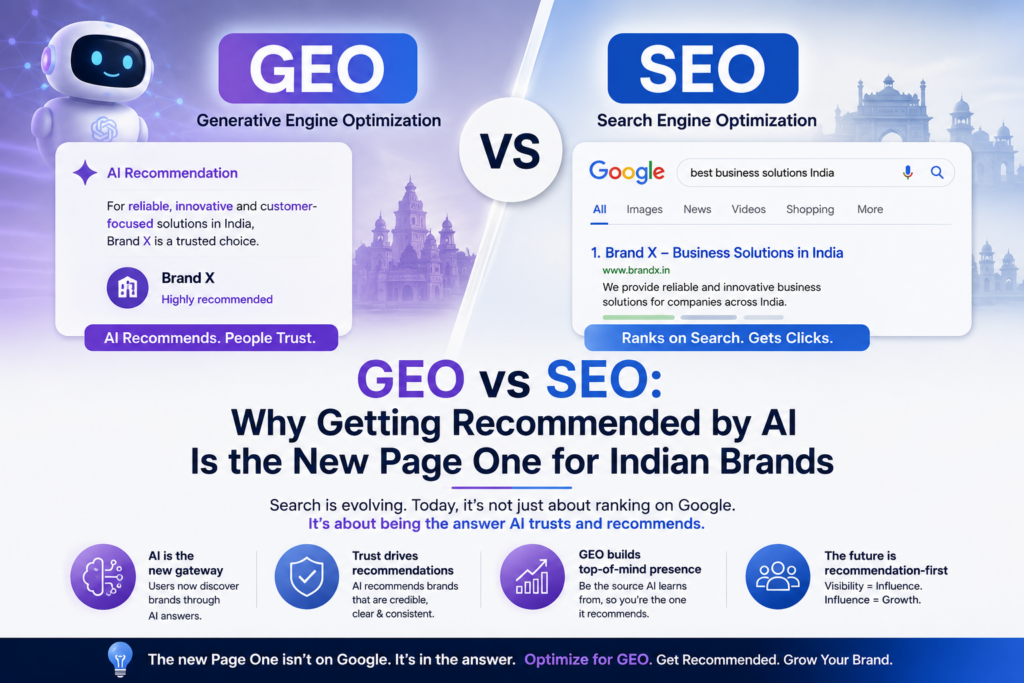
The term distinguishes this practice from traditional SEO, which focuses on ranking in the ten organic results that Google returns for a search query. In the traditional search model, being on Page 1 meant appearing in those ten results, with position one being most valuable. In the generative model, the AI engine synthesises information from multiple sources and produces a single, conversational response — often naming one or two brands or sources directly. There is no Page 1. There is only the answer, and whether your brand is in it or not.
How generative engines decide what to recommend
Understanding what drives GEO requires understanding how AI language models produce their answers. These models are trained on vast amounts of text from the internet — articles, reviews, forum discussions, product descriptions, academic papers, news coverage. When a user asks a question, the model draws on this training to construct the most accurate, relevant, and credible response it can.
The brands and sources that appear in these responses are the ones that are most prominently and consistently represented in the high-quality text that the model was trained on and continues to reference. This means: brands covered by reputable publications, brands that generate consistent and authoritative content about their own category, brands that are discussed in trusted review environments, and brands whose claims and expertise are corroborated across multiple independent sources.
In simple terms, AI engines recommend brands that the internet already considers authoritative and credible. Which means that the foundation of GEO is the same as the foundation of good SEO and good digital PR — genuine authority, built through quality content, credible coverage, and consistent expertise signals across multiple platforms.
SEO asks: are we ranking? GEO asks: are we being recommended? The discipline is the same. The destination has changed.
SEO vs GEO: What Is the Same and What Is Different
Before examining what needs to change, it is worth being clear about what stays the same — because the most important implication of GEO is not that SEO is obsolete. It is that SEO’s foundations have become even more important.
What stays the same
The core signals that make a brand authoritative in Google’s organic results are the same signals that make it likely to be cited in AI-generated responses. High-quality, original, genuinely useful content that comprehensively addresses questions relevant to the brand’s category. Domain authority built through credible inbound links from reputable sources. Consistent E-E-A-T signals — Experience, Expertise, Authoritativeness, Trustworthiness — across all the brand’s digital touchpoints. Technical SEO fundamentals that ensure content is properly indexed and accessible.
Brands that have invested seriously in these foundations over the last three to five years are already in a stronger GEO position than brands that have not — because the training data and reference sources that AI engines draw on are weighted toward the authoritative content those brands have built. The investment was not wasted. It has, in fact, become more valuable.
What changes
Several things change meaningfully in a GEO world, and each deserves specific attention.
The format of content matters differently. Google rewards content that is structured for scanning — clear headings, concise paragraphs, well-organised information hierarchies. AI engines reward content that directly and clearly answers specific questions in natural language. The shift is from structure optimised for a search results page to structure optimised for being quoted or summarised accurately in a conversational response. Content that answers questions in clear, definitive, quotable sentences is more likely to be drawn upon by a generative engine than content that buries its key points in discursive paragraphs.
Brand mentions across the web matter more. In traditional SEO, the primary off-page signal is inbound links. In GEO, the signal is broader — brand mentions, citations, references, and coverage across a wide range of reputable sources, including sources that may not link back to the brand’s website at all. A brand that is consistently discussed in industry publications, consumer review platforms, news coverage, and expert commentary is training AI models to recognise it as a credible answer to relevant questions. This shifts more weight toward digital PR, content syndication, and third-party coverage.
The measurement framework is different. Traditional SEO is measured through rankings, organic traffic, and conversions attributable to organic search. GEO’s impact is harder to measure directly — because when a consumer gets a brand recommendation from ChatGPT and navigates directly to the brand’s website, it typically registers as direct traffic rather than organic search. Brands that are succeeding in GEO may see organic traffic stagnate or decline even as brand-driven direct traffic and sales increase. Recognising this pattern — and not misinterpreting declining organic traffic as declining performance — is one of the first measurement adjustments GEO requires.
The question framework changes. People search on Google with short keyword phrases. They ask AI engines questions — natural language, conversational, often specific and multi-part. A Google user might search “best mutual fund India.” A ChatGPT user might ask “what is the best mutual fund for a 35-year-old in India who wants low risk and is saving for retirement in 20 years?” Content optimised for GEO needs to be built around the full range of questions that a real consumer might ask an AI engine, not just the keyword phrases they might type into a search bar.
The India Dimension: Why This Matters Specifically Here
GEO is a global phenomenon, but its implications for Indian brands have specific characteristics that are worth examining separately.
AI search adoption in India is accelerating
ChatGPT adoption in India has been among the fastest globally since its launch. Urban Indian consumers — particularly the 25–40 demographic that represents the core of most premium and considered-purchase categories — have integrated AI tools into their daily information and decision-making workflows at a pace that has surprised even optimistic observers. For product research, brand comparison, financial decisions, health queries, and travel planning, AI-assisted search is increasingly the first step rather than a supplementary one.
This is not a future trend for India. It is a present behaviour among the consumer segment that most aspirational Indian brands are competing for. The brand manager who is planning for GEO as a 2027 priority is already behind in 2026.
The English-language authority gap
AI language models are predominantly trained on English-language content, and their citation behaviour reflects this. Indian brands with strong regional language content but limited authoritative English-language coverage may be invisible to AI engines even if they are well-known in their regional markets. This creates a specific challenge for regional Indian brands — and a specific opportunity, because the window to build English-language authority before AI search penetration reaches regional language audiences is still open, though not indefinitely.
For national Indian brands, the implication is different. The brands most likely to be cited in AI responses to questions about Indian consumer categories are the ones with the strongest English-language digital footprint — coverage in The Economic Times, Mint, Business Standard, YourStory, The Ken, and similar publications that AI models are heavily trained on. Building that coverage is not just a PR exercise. In a GEO world, it is a direct investment in search visibility.
Category leadership in AI responses
In most Indian consumer categories, AI engines are currently defaulting to a small number of consistently recommended brands — typically those with the strongest national digital presence and the most comprehensive online coverage. The category positions being established in AI responses right now are early and relatively open. A brand that invests in GEO fundamentals in 2026 is competing for positions that are not yet locked in — unlike Google’s most competitive keywords, where established players have built years of domain authority that is genuinely difficult to displace.
This is the first-mover opportunity that GEO presents for Indian brands. The brands that build AI visibility now, before AI search becomes the dominant consumer behaviour, will be significantly better positioned than those that wait until the positions are established and expensive to challenge.
What Indian Brands Should Do Right Now
GEO is not a separate discipline that requires a separate agency, a separate budget, or a separate strategic plan. It is an evolution of the content, SEO, and digital PR work that brands should already be doing — adjusted in specific ways to reflect how generative engines work. Here is what that adjustment looks like in practice.
1. Audit what AI engines currently say about your brand
The starting point for any GEO strategy is understanding the current state. Ask ChatGPT, Gemini, and Perplexity the questions your target consumers are most likely to ask about your category. “What is the best brand for X in India?” “Which company should I trust for Y?” “What are the top options for Z under [price point]?” Note which brands are named, how they are described, and whether your brand appears. This audit tells you where your GEO gaps are and which competitors are already establishing AI visibility in your category.
2. Build content that answers questions, not just ranks for keywords
Review your content strategy through a question-answering lens rather than a keyword-density lens. For every significant topic area relevant to your brand, identify the specific questions a consumer might ask an AI engine — and create content that answers those questions directly, comprehensively, and in natural language. The content does not need to be structured around keyword repetition. It needs to be structured around genuine, clear, quotable answers to real consumer questions.
FAQ sections, detailed buying guides, expert explainers, comparison content, and “how to choose” articles are all formats that AI engines draw on heavily when constructing recommendations. Brands with strong libraries of this type of content are consistently better represented in AI responses than those with primarily promotional or campaign-oriented content.
3. Invest in third-party coverage and digital PR
AI engines do not just draw on a brand’s own website. They draw on everything the internet says about the brand — reviews, news coverage, expert commentary, industry analysis, social discussion. The breadth and quality of third-party coverage is one of the strongest signals that a brand is genuinely authoritative rather than self-promotional.
For Indian brands, this means actively pursuing coverage in the publications that AI models weight most heavily: national business and consumer publications, credible industry media, respected review platforms, and expert commentary in relevant subject areas. A consistent digital PR programme that generates regular, substantive coverage in these outlets is a direct GEO investment — not just a brand building one.
4. Ensure your E-E-A-T signals are explicit and strong
AI engines are particularly sensitive to expertise and trust signals. For a brand’s content to be cited in responses, the model needs to be able to assess that the content comes from a credible source. This means making authorship credentials explicit — who wrote this, what qualifies them to speak on this subject. It means ensuring that factual claims are accurate and consistent across all the brand’s content. It means having clear, trustworthy information about the brand itself — who it is, where it operates, how long it has been in business, what independent sources say about it.
Many Indian brands have strong implicit credibility — they have been in business for years, they serve large customer bases, they have received independent recognition — but that credibility is not explicit enough in their digital footprint for AI engines to confidently cite them. Making the signals explicit is often a quick win with disproportionate GEO impact.
5. Optimise for featured snippets and structured data
Featured snippets — the direct answer boxes that appear at the top of some Google results pages — are one of the primary sources that AI engines draw on when constructing responses. Brands that consistently win featured snippets for category-relevant queries are well-positioned for GEO, because the same content characteristics that earn featured snippets also make content more likely to be used in AI responses.
Structured data markup — schema.org tags that help search engines understand the context of content — is also increasingly relevant in a GEO context. Product schema, FAQ schema, review schema, and organisation schema all provide machine-readable signals about a brand’s products, reputation, and credibility that AI engines can incorporate into their responses.
6. Monitor AI brand representation actively
GEO measurement is still developing, but the basics are achievable now. Regularly querying AI engines with category-relevant questions gives a qualitative picture of brand representation. Tracking direct traffic and brand search volume trends alongside organic traffic — and looking for the pattern of rising direct traffic with stable or declining organic traffic — reveals GEO impact that would otherwise be misread as performance decline. And monitoring shifts in brand mention volume across the web, using social listening and media monitoring tools, captures the third-party coverage growth that feeds AI authority.
What GEO Does Not Change
It is worth being explicit about what GEO does not replace or make redundant — because the risk of any new trend in digital marketing is that it gets treated as a reason to abandon the foundations that actually work.
Google search is not going away. The majority of Indian search queries are still conducted on Google, and organic Google rankings still drive a significant proportion of digital brand discovery. SEO remains essential. GEO is an addition to SEO, not a replacement for it.
Performance marketing is not made obsolete by GEO. Paid search and paid social still capture in-market demand efficiently. The consumer who has been recommended a brand by ChatGPT and then searches for it on Google is an ideal paid search target — pre-qualified, high-intent, and likely to convert. GEO and performance marketing work together in the same way that brand advertising and performance marketing work together.
Brand building across all channels is still the foundation. AI engines recommend brands that the internet already knows and trusts. The brand that has invested in television, in quality digital content, in consistent media presence, in genuine product quality and customer experience — that brand is building the reputation that makes it recommendable. GEO tactics without the underlying brand substance produce very little. The substance comes first.
AI engines recommend brands the internet already trusts. The work of building that trust has not changed. The channels through which it shows up have.
Conclusion
The consumer behaviour shift that GEO responds to is real, accelerating, and already affecting how Indian brands are discovered. Traffic that does not register in analytics. Sales that seem to come from nowhere. Brand recommendations that happen in AI conversations that no marketing tool can currently see.
The brands that will lead their categories in AI search visibility over the next three years are not necessarily the ones with the largest digital budgets. They are the ones that have built genuine authority — through quality content, credible third-party coverage, consistent expertise signals, and a brand reputation that the internet corroborates independently. Those are exactly the same foundations that good SEO, good digital PR, and good brand marketing have always required.
What changes is the urgency and the measurement. The urgency, because the category positions in AI responses are being established now — and early movers will have a structural advantage that compounds over time, just as early SEO investment produced domain authority advantages that took competitors years to close. The measurement, because the old proxies — organic traffic, Google rankings — are becoming incomplete pictures of how visible a brand actually is to consumers who are starting their search journey with an AI engine.
At Alliance, we have been helping Indian brands build digital visibility for over 30 years — across search, social, content, and media. We are integrating GEO thinking into how we plan content strategy, digital PR, and SEO for our clients — because the discipline is not new, but the destination has changed. If you are wondering whether your brand is positioned to be recommended rather than just ranked, that is a conversation worth having sooner rather than later.
Disclaimer: All brand names mentioned — including Google, ChatGPT, Gemini, and Perplexity — are trademarks of their respective owners. Their mention is purely for illustrative and informational purposes. Alliance Advertising & Marketing Private Limited has no affiliation with or endorsement from any of these companies.