
Table of Contents
Every year for the last decade, someone in a media planning meeting has said some version of the same thing: “Print is dying. Should we really be spending here?” The question has become so routine that it is now almost a reflex — a way of signalling that the speaker is digitally aware, forward-thinking, not trapped in the past.
The problem is that it is not supported by the facts of the Indian market.
India is the largest newspaper market in the world by copies sold. The Indian Readership Survey and publisher data consistently show hundreds of millions of readers engaging with print — not as a nostalgia habit, but as a genuine daily media touchpoint that commands a quality of attention that most digital formats simply do not. Hindi and regional language newspapers in particular reach audiences at depth and trust levels that no digital platform has yet replicated in the same markets.
Print is not dying in India. It is being misunderstood — by marketers whose reference points are Western media consumption trends, by digital-first planners who measure all channels against the attribution standards that only digital can meet, and by brands that have reduced their print investment year after year based on a narrative rather than an analysis of what print is actually delivering for them.
This post makes the affirmative case for newspaper advertising in India in 2026. Not as a defence of the past, but as a straightforward argument grounded in what the medium does, who reads it, and why it continues to be a commercially valuable part of a well-planned media strategy for a wide range of Indian brands.
The Narrative Versus the Numbers
The “print is dead” narrative is largely imported from Western markets — particularly the United States and the United Kingdom — where newspaper circulation has declined dramatically and many legacy publications have shut entirely or migrated to digital-only models. That story is real and relevant in those markets. It is not the Indian story.
India’s newspaper market has characteristics that are fundamentally different from Western markets. Literacy rates have been rising, not falling, adding new readers to the print audience. Regional language newspapers — serving audiences whose first language is Hindi, Telugu, Tamil, Marathi, Bengali, Kannada, Gujarati, or Punjabi — have built reader relationships that are rooted in identity and cultural trust, not just information consumption. And the economic model of Indian newspapers, supported by advertising and sold at subsidised cover prices that make them accessible across income levels, has proved more resilient than Western equivalents.
The Audit Bureau of Circulations and readership surveys have shown consistent print readership in the hundreds of millions across India. Dainik Jagran, Dainik Bhaskar, Hindustan, Amar Ujala, and their regional language equivalents reach populations that dwarf the readership of most English language print or digital publications. These are not shrinking numbers — they reflect a reading culture that is structurally different from the one in markets where print’s obituary was written.
India is the world’s largest newspaper market. The “print is dead” narrative describes a different country.
English language newspapers — Times of India, Hindustan Times, The Hindu, Economic Times, Business Standard — have seen pressure similar to Western markets, and their circulation reflects a more digitally-migrated readership. But English language readership has never been the primary commercial proposition of Indian print. The commercial case for newspaper advertising in India rests primarily on Hindi and regional language publications, where the readership base, the reader trust, and the advertiser competition look very different.
Who Actually Reads Newspapers in India — And Why It Matters
The decision to include or exclude print from a media plan should start with a clear-eyed look at who the print reader actually is — not who the planner assumes the print reader is.
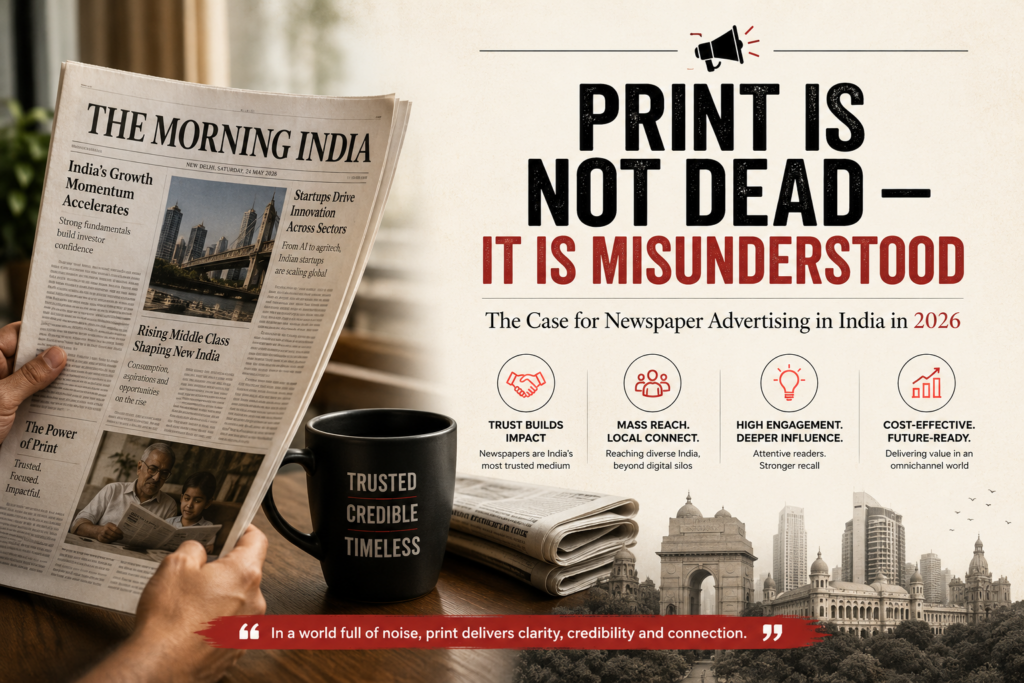
The Indian newspaper reader is, on average, more educated than the general population, more economically active, and more engaged with the content they are consuming. Unlike passive television viewing or scrolling social media, newspaper reading is an active, chosen behaviour. The reader has picked up the paper, turned to a section, and is reading by choice. That active engagement creates an advertising environment that is qualitatively different from interruptive digital formats.
In Hindi-speaking markets — UP, Bihar, Madhya Pradesh, Rajasthan, Jharkhand — regional language newspapers like Dainik Jagran, Dainik Bhaskar, Hindustan, and Amar Ujala are daily habit for a broad cross-section of the population. The teacher who reads Jagran over morning chai. The small business owner whose daily Bhaskar is part of how he stays informed about the world. The family where the newspaper is shared across three generations. These are not marginal or declining readers — they are the mainstream of these markets.
For brands whose commercial opportunity is concentrated in these markets — FMCG, consumer durables, financial services, healthcare, education, real estate — the Hindi newspaper reader is not a secondary audience. In many cases, they are the primary audience. And the media plan that ignores print in these geographies is ignoring a significant portion of the very consumers it is trying to reach.
The regional language trust premium
One dimension of print readership that rarely features in media planning discussions is the trust relationship between regional language newspaper readers and their publication. In many Indian markets, the local or regional newspaper is not just an information source — it is a trusted community institution. Readers have often subscribed to the same paper for years or decades. They trust its news judgment. They believe its advertising reflects genuinely available products and services.
This trust transfers, in part, to the advertising environment. An advertisement in Eenadu in Andhra Pradesh or Mathrubhumi in Kerala or Sakal in Maharashtra carries a contextual credibility that a digital ad on the same consumer’s phone does not. The brand that chooses to advertise in a publication the reader trusts has, by that choice, borrowed some of that trust. For brands building credibility in regional markets — particularly brands from outside the region — this contextual endorsement is a real commercial asset.
What Newspaper Advertising Does Better Than Digital
A fair assessment of print requires being specific about what it does well — not as a general claim that “print works,” but as an identification of the specific advertising objectives for which newspaper is genuinely superior to digital alternatives.
High-information advertising
Newspaper advertising is uniquely suited to the communication of complex, detailed information. A full-page or half-page newspaper advertisement has space for specifications, pricing, comparisons, terms and conditions, store locations, and other information that consumers need to make considered purchase decisions. This format is effectively impossible to replicate in digital display advertising, and expensive and clunky in television.
For categories where the purchase decision involves significant information processing — real estate, automobiles, consumer electronics, financial products, insurance, education — the newspaper advertisement that gives the consumer the information they need to act is genuinely more effective than a digital ad that can communicate only a headline and a click prompt. This is why property developers, car manufacturers, and financial services brands have maintained significant print investment even as digital alternatives have multiplied.
Announced events and time-sensitive communication
Newspaper advertising is the most effective mass medium for announcing something specific that is happening on a specific date. A sale starting tomorrow. A store opening this weekend. A new product available from Monday. An event happening in three days. The combination of wide, rapid reach and concrete date-based communication makes newspapers the default choice for announced events in most Indian markets.
E-commerce brands and retailers consistently use newspaper advertising — particularly front-page strips, jacket ads, and half-page announcements — to communicate sale events. The ROI on this specific application of print is often excellent, because the newspaper reach amplifies awareness of the event to audiences that digital channels have not yet reached, driving first-time website visits and app downloads from consumers who would not otherwise have known the sale was happening.
Reaching the digitally under-served
Despite India’s rapid digital growth, significant populations in tier-2 and tier-3 cities and in rural markets remain light digital users — particularly among consumers over 40, in lower-income households, and in markets where smartphone penetration is more recent. These consumers are not invisible to media planners — they are significant purchasers across a wide range of categories — but they are systematically harder to reach through digital channels alone.
For brands with genuine distribution in these markets, newspaper advertising remains the most practical way to build mass awareness. A single insertion in a high-circulation regional daily can reach more consumers in a specific market than a digital campaign with a comparable budget, because the digital campaign is competing for the attention of a smaller, more contested online audience while the newspaper reaches a broader population including many who are not addressable digitally.
The morning mindset advantage
When and where a consumer encounters an advertisement shapes how they process it. Newspaper advertising reaches consumers in the morning — when they are alert, engaged, in planning mode for the day ahead, and more likely to act on commercial information. The consumer reading about a sale in the morning paper has the whole day ahead to visit the store or the website. The consumer who sees a digital ad at 11pm is in a different cognitive state entirely.
This morning-mindset advantage is particularly relevant for categories where the purchase decision is made during the day — retail, banking, healthcare appointments, automotive test drives — and where reaching the consumer at the start of the day is genuinely more valuable than reaching them in the evening digital window.
The Formats That Work — And the Ones That Do Not
Part of the misunderstanding of print advertising is treating all newspaper advertising as equivalent. It is not. Some formats and placements deliver excellent return on investment. Others, frankly, do not — and continuing to use ineffective formats is a legitimate reason for dissatisfaction with print, but it is not evidence that the medium itself does not work.
Front page and front-of-section positions command significant premiums but deliver them. Visibility, context, and reader engagement are all higher in these positions. For launches, major announcements, and festive campaigns, the premium is typically justified.
Jacket advertisements — where the newspaper is literally wrapped in an advertiser’s creative — are among the highest-impact formats in Indian print and consistently produce measurable brand salience lifts. They are expensive, which means they are appropriate for significant brand moments rather than routine campaigns.
Full-page and half-page colour advertisements in the main broadsheet provide the space for high-information creative that is print’s specific advantage. Used well, with clear product information, compelling creative, and a specific call to action, these formats work effectively for considered-purchase categories.
Classified and small-format advertising in run-of-paper positions, on the other hand, is where print advertising most often fails to justify its cost. Small, poorly positioned black-and-white advertisements in cluttered sections deliver low visibility and low impact. If this is the predominant form of print investment a brand has tried, it is not an adequate test of what newspaper advertising can deliver.
Supplement advertising — weekend magazines, branded pull-outs, festive editions — offers an environment of higher reader engagement and longer dwell time than the daily paper. For lifestyle, fashion, home decor, and aspirational brand categories, supplement advertising can deliver impact that the daily paper does not.
How Print and Digital Work Together
The most productive way to think about newspaper advertising in 2026 is not as an alternative to digital but as a complement to it. The two channels reach audiences at different moments, through different mechanisms, and with different strengths. Used together intelligently, they produce better combined outcomes than either alone.
A newspaper advertisement that announces a sale drives consumers to search for the brand online. That brand search is then captured at low cost by a paid search campaign that was prepared in advance to handle the uplift. The print ad creates the intent. The digital campaign converts it. Neither step works as well without the other.
Similarly, a digital retargeting campaign reaches consumers who have already visited a website — but it does not reach the consumer who has never heard of the brand. A newspaper advertisement in the right regional publication reaches that consumer, creates awareness, and puts them into the digital retargeting pool for the first time. The print advertisement is the top of the funnel. The digital campaign manages the rest.
This integrated planning logic — where print and digital are designed to work in sequence rather than in competition for the same budget — is where the strongest return on print investment is found. Brands that plan print in isolation from their digital campaigns consistently underestimate its contribution, because the conversion that print triggers often registers as digital or direct in an attribution model that cannot see the print exposure.
Print creates the intent that digital converts. Planning them separately means neither is working as hard as it should.
Which Brands Should Be Investing in Print Right Now
Print advertising is not right for every brand at every stage. Here is a straightforward framework for thinking about whether newspaper advertising belongs in a media plan.
Strong candidates for print investment
- Real estate and property developers whose customers make high-consideration, location-specific decisions that benefit from detailed information and local media trust.
- Automotive brands announcing new models, test drive events, or limited-time offers to audiences who read automotive sections with genuine purchase intent.
- Financial services and insurance brands where the trust signal of reputable print media is commercially significant and where regulatory requirements often benefit from the space that print provides.
- Retail and e-commerce brands announcing specific sales or events to audiences in markets where digital reach is insufficient to cover the full opportunity.
- FMCG brands with significant distribution in Hindi-speaking and regional markets where newspaper readership is deepest and digital penetration less complete.
- Educational institutions whose admissions cycle creates a specific, time-bound communication need that newspaper advertising has always served effectively.
- Healthcare and pharmaceutical brands requiring high-information communication with a trusted-source context that print provides better than digital.
Brands for whom print requires careful justification
Brands targeting exclusively urban youth audiences aged 18–28, or operating entirely in digital-native categories with no physical retail or regional presence, will find it harder to justify significant print investment. This is not because print does not reach young urban consumers — it does, at lower rates — but because the cost-efficiency of print relative to digital is lower for these specific segments, and the opportunity cost of print spending is higher.
For these brands, a token print presence in key English-language business publications — for trade audience and brand credibility purposes — may be more appropriate than a broad-reach Hindi newspaper campaign.
The Measurement Problem — And How to Address It
The most legitimate objection to print advertising is not that it does not work. It is that it is harder to measure than digital. And in organisations where marketing effectiveness is evaluated primarily through digital attribution, print’s unmeasured contribution is systematically discounted.
This is a real problem, but it is addressable. Several measurement approaches work reasonably well for print:
- Unique response mechanisms — dedicated phone numbers, unique URLs, specific discount codes, or QR codes in print advertisements — allow direct response from print to be tracked separately from other channels. The volume of responses through these mechanisms provides a floor estimate of print’s direct contribution.
- Brand search uplift tracking — monitoring Google Search Console data for branded search volume before, during, and after a print campaign — reveals whether print exposure is driving consumers to search for the brand online. This is particularly visible when large-format or high-circulation placements coincide with measurable spikes in search volume.
- Geographic test-and-control analysis — comparing performance metrics in markets where print investment is concentrated against matched markets without print — provides a causal estimate of print’s contribution to digital and sales performance.
- Consumer research and brand health tracking — asking consumers in print-heavy markets about brand awareness and ad recall, compared to control markets — provides direct evidence of print’s brand-building impact.
None of these approaches provides the precise, real-time attribution that digital offers. But the expectation that print should be measured like a Google Ads campaign is itself a category error. Print is a brand-building medium. Its measurement framework should reflect what it is actually doing — building awareness, establishing trust, communicating information — not what digital does.
What Good Print Planning Looks Like
The brands getting the most from print investment in India right now are doing several things consistently:
They are choosing publications based on audience composition data rather than circulation headlines. A newspaper with a smaller circulation but a more precisely relevant readership for the brand’s target consumer is often a better buy than a higher-circulation paper with a more diffuse audience.
They are investing in format quality. A well-designed, full-colour, premium-positioned newspaper advertisement communicates brand quality. A small, cluttered, black-and-white ad in a crowded section does not. The creative investment in print deserves to be proportionate to the media investment.
They are planning print in explicit coordination with their digital campaigns — using print to generate awareness and search intent that digital is prepared to capture and convert. The print media plan and the paid search campaign are planned in the same room, not by different teams in different conversations.
And they are evaluating print with measurement frameworks appropriate to brand-building media — not applying digital attribution standards to a medium that operates on a different logic and a longer timeline.
Conclusion
Newspaper advertising in India is not dying. It is being under-planned and under-measured by a generation of marketers whose mental models were formed in markets where print’s decline is genuine and in an industry whose measurement infrastructure favours digital.
For brands operating in Hindi-speaking and regional Indian markets, for brands communicating complex or high-information content, for brands making specific time-bound announcements, and for brands that need the trust signal that a reputable regional publication provides — newspaper advertising remains a commercially valuable and often under-priced media investment.
The right question is not “is print dead?” The right question is “what does print do for my specific brand, in my specific markets, among my specific target consumers — and am I planning and measuring it in a way that accurately reflects that contribution?” For most Indian brands with genuine regional distribution and audiences beyond the digitally-active urban core, the honest answer to that question makes a case for print that the reflexive dismissal of the medium does not.
At Alliance, we have been buying print for Indian brands for over 30 years — from full-page national daily insertions to precision regional buys in specific language markets. We know which publications deliver, what formats work for which categories, and how to integrate print intelligently with digital campaigns so that the combined investment performs better than either alone. If your current media plan has quietly de-prioritised print based on narrative rather than analysis, that conversation is worth having.